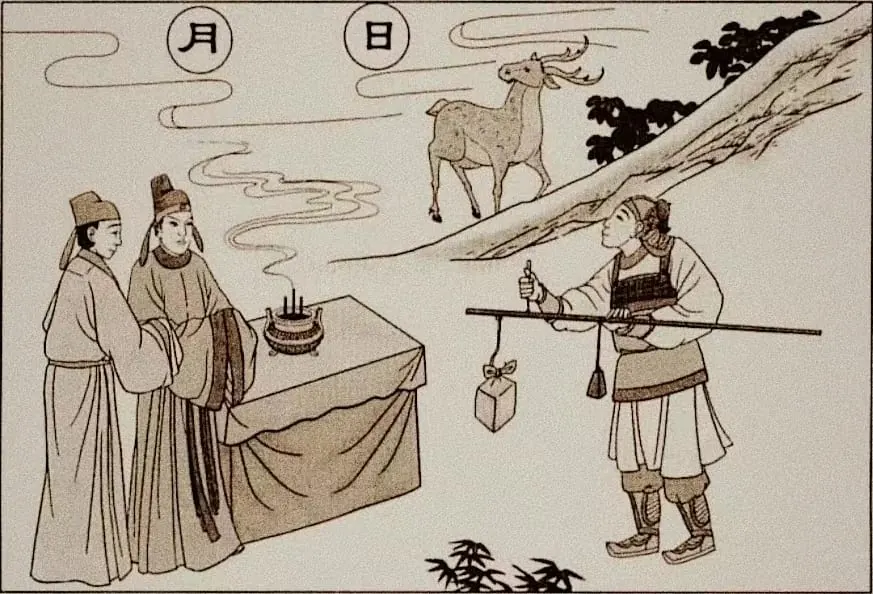
Scene Description
Image Symbolism
Reading the Picture
Guan is the hexagram of looking and being looked at: a scene of quiet reverence, in which the people in view set the tone for everyone who watches them.
Start at the incense table. Two officials in formal robes stand beside it as smoke rises from the burner; the written description names only one. This is the moment the judgment describes: hands washed, offering not yet made, attention at its most collected. Above hang the sun and the moon, drawn as labelled discs, which the Image Symbolism reads as clear light falling evenly on everything.
Facing them, a guard in armour carries a steelyard, a balance pole, with a wrapped seal hanging from it. He is bringing authority to be handed over, and the balance hints that it should be weighed fairly. On the slope behind him stands a deer, a pun on 鹿 lù and 禄 lù, an official’s reward, placed high on the mountain. The trigrams echo the mood: Earth ☷ below, Wind ☴ above, wind passing over the land and touching everything, as a good example reaches people without force.
The picture fits the fourth line best: observing the nation’s splendor and becoming the king’s guest. The fifth line gives the other side: whoever is watched should judge themselves by the people below.
- Work
- If you lead or work in plain view, consider what others learn simply by watching you. If you are weighing an offer, look at how the place actually behaves, not only at the reward on the mountain.
- Relationships
- Ask whether you are seeing the other person whole or only through a narrow gap, as in the second line. Steady sincerity says more than occasional gestures.
- Timing
- This favours observing before acting. If a decision is near, take time to watch how things really run, then advance or step back, as the third line advises.
Line Statements
Listed from the bottom line to the top line.
- First six: A child's observation. No blame for a petty person; regret for a noble person.
- Six in the second place: Peering through a gap. Beneficial for a woman's steadfastness.
- Six in the third place: Observe my life; advance or retreat.
- Six in the fourth place: Observe the nation's splendor. It is beneficial to be the king's guest.
- Nine in the fifth place: Observe my life. The noble person has no blame.
- Top nine: Observe their life. The noble person has no blame.
Meaning of the Hexagram
Translated from the Chinese 人间道 commentary with AI assistance; translator notes appear in brackets.
“Guan: the hands have been washed but the offering not yet presented; there is sincerity, with a reverent bearing.”
At the start of a sacrifice, when one seeks the spirits, the mind is at its most concentrated. One in a high position corrects his bearing so as to be what the people below look to. If from beginning to end he can keep the people’s watching as concentrated as it was at the very start, he has fulfilled the way of Guan (Contemplation). Today, once people reach the ruler’s position, the rites multiply, so that people’s minds scatter and their concentration is not what it was at the beginning.
“The great view is above; compliant and gentle, central and correct, it is seen by all under heaven.”
The person in the fifth place, the place of honour, who has the virtue of yang firmness, centrality and correctness and stays the same from beginning to end, is seen by those below; such a person will surely keep his focus.
“Guan: the hands have been washed but the offering not yet presented; there is sincerity, with a reverent bearing: those below look on and are transformed.”
The way of being looked to requires strictly keeping the concentration of the beginning; then the people below will surely look up in complete sincerity and follow the teaching. “Not presenting the offering” means not letting one’s sincerity scatter even a little.
“Contemplating the spiritual way of heaven, the four seasons never err; the sage uses the spiritual way to establish teaching, and all under heaven submit.”
The way of heaven is supremely spiritual, hence it is called the spiritual way. The sage observes heaven moving through the four seasons without ever erring; such is its spiritual wonder. The sage embodies this spiritual way to establish teaching, and therefore all under heaven submit.
“Wind moves over the earth: Contemplation. The former kings accordingly inspected the regions, observed the people, and established teaching.”
Wind moving over the earth touches all things. The sage embodies this: he knows to tour and inspect the four quarters, observe the customs of the people, and set up government and teaching. For example, when he sees extravagance he restrains it with frugality, and when he sees deceit he corrects it with what is right. Then the people will look to him.
“A child’s observation. No blame for a petty person; regret for a noble person.”
This line is in the lowest position and is yin and soft by nature, far from the yang firm lines; therefore its view is as shallow as a child’s, hence “a child’s observation.” When petty people look upon the way of yang firmness, they do not recognise the way of the noble person, and at the start of contemplation this actually brings them no harm. But if a noble person’s view were as dim and shallow as this, it would be shameful.
“The child’s observation of the first six is the way of the petty person.”
One whose view is as unclear as a child’s is truly a petty person; hence it speaks of the way of the petty person.
“Peering through a gap. Beneficial for a woman’s steadfastness.”
Peering means seeing little and not clearly. The second line occupies the place of a commander [将位, as written], yet cannot see clearly the way of yang firmness, centrality and correctness. This is like the way of a woman: she does not see very clearly, yet she is able to comply. If a person in this position can comply as a woman does, he will not lose what is right; hence it is beneficial.
“Peering through a gap, a woman’s steadfastness: this too is shameful.”
This means that a noble person who cannot see the great virtue of yang firmness, centrality and correctness, even if he is able to comply, is no different from a woman. This too is shameful.
“Observe my life; advance or retreat.”
A soft nature in the position of a minister, at the time of contemplation: its way of advancing and retreating is for its own sake. Although this is not correct, it is not excessive either.
“Observing my life to advance or retreat: the way is not yet lost.”
By observing oneself one knows the way to survive, and advances or retreats accordingly; this does not lose the way.
“Observe the nation’s splendor. It is beneficial to be the king’s guest.”
Although the fourth line is yin and soft, it is in the position beside the ruler and can see the glory and greatness of the nation, from which the ruler’s virtue can be seen. Because the ruler in the fifth place is a wise and enlightened person, men of talent and virtue all wish to come to court to assist him and to bring relief to the world. Conversely, because a wise ruler can employ and respect people of talent and virtue, talent gathers around him.
“Observe the nation’s splendor: it values being a guest.”
A noble person keeps his talent to himself because there is no enlightened ruler. Once he sees the flourishing virtue and splendor of the nation, he resolves to rise to the royal court and put his way into practice.
“Observe my life. The noble person has no blame.”
The person in the ruler’s position of the fifth line embodies the way of contemplation: he looks at the customs of the world and so comes to know himself. If the customs of the world do not accord with the way of the noble person, that comes from what he himself has done; his government must be poor, and he cannot but blame himself.
“Observe my life: that is, observe the people.”
If a ruler wants to see whether his government is good or not, he should look at the people. If the people’s customs are good, his government and its influence must be good. This is what Wang Bi meant by “observe the people in order to examine one’s own way.”
“Observe their life. The noble person has no blame.”
The top nine is a line not in its proper position, occupying it with yang firmness. It is like a worthy noble person who holds no office, yet whose virtue is looked up to by all under heaven. Those who can be like this are all noble people.
“Observe their life: the will is not yet at peace.”
When we observe how such a person lives, he never falls short of the noble person; although he holds no office, he still does not fail the teaching and influence that people hope for from him.
Show the Chinese original (人间道)
观:盥而不荐,有孚顒若。 人于祭祀之始,求神之时,心念最专精之时也。居上位者,正其仪表,以为下民之观,当 始与终,皆能令民之观如初始之专精,则尽观之道也。今人至君位后,礼数繁多,致令人心散, 精一不如初始也。
大观在上,顺而巽,中正以观天下。 五居尊位之人,能以阳刚中正之德,始终如一,为下所观见,则必能精一也。 观,盥而不荐,有孚顒若,下观而化也。 处观之道须严守如始之精一,则下民必至诚瞻仰而从教化,不荐为不使诚意少散。 观天之神道,而四时不忒,圣人以神道设敎,而天下服矣。
天之道至神,故曰神道。圣人观天之运行四时,从无差错,其神妙如此。圣人体神之道而 以设教,故天下服也。
风行地上,观。先王以省方、观民、设敎。 风行地上,能触万物,圣人体之,知巡省四方,观视民俗,设为政教,例如见奢则约之以 俭,见奸则矫之以正,则民将观之。
童观,小人无咎,君子吝。 处最下之位,又为阴柔之本质,离阳刚过 远,是故其观浅如童稚,故曰童观。小人观阳 刚之道,不识君子之道,于观之初,反而无灾, 如见君子亦昏浅如是,则可羞也。
初六童观,小人道也。 此所观不明如童稚,此实小人也,故言小 人之道。
闚观,利女贞。 观,乃少见而无甚明也。二居将位,而不能明见阳刚中正之道,则如女子之道,即见之不 甚明,又能顺从者。将位之人,能如女子之顺从,则不失其正,故利。
闚观女贞,亦可丑也。 此即君子之人不能观见阳刚中正之大德,虽能顺从,乃同女子也。亦可羞也。
观我生,进退。 柔质居相位,处观之时,其进退之道,乃 为己者,虽非正,.亦不为过也。
观我生进退,未失道也。 观己知生存之道,而以之进退,此未失道 也。
观国之光,利用宾于王。 四虽阴柔居君侧之位,能观见国之光辉盛 大,可见人君之道德也。此因九五君位为圣明 之人,致令才德之士 ,皆愿进朝廷辅佐,以 济天下。反之圣君因能用敬才德之人,则人才 聚之。
观国之光,尚宾也。 君子怀才自守,乃因无明主也。既观见国 之盛德光华,则志愿登进王朝,以行其道。
观我生,君子无咎。 九五君位之人,体观之道,其视天下之俗 而知己,若天下之俗,不合乎君子之道,则是 己之所为,政治必不佳,不可不怪自己。
观我生,观民也。 人君欲观己之施政良否,当观于民,民俗 善,则政化必善。此意即王弼云『观民以察己 之道』。
观其生,君子无咎。 上九为不当位之人,以阳刚处之,如同贤 人君子不在其位,而道德为天下所观仰,能如 此,皆君子也。
观其生,志未平也。 吾人观其生存之道,常不失于君子,虽不 在位,则亦不失人所望之教化也。