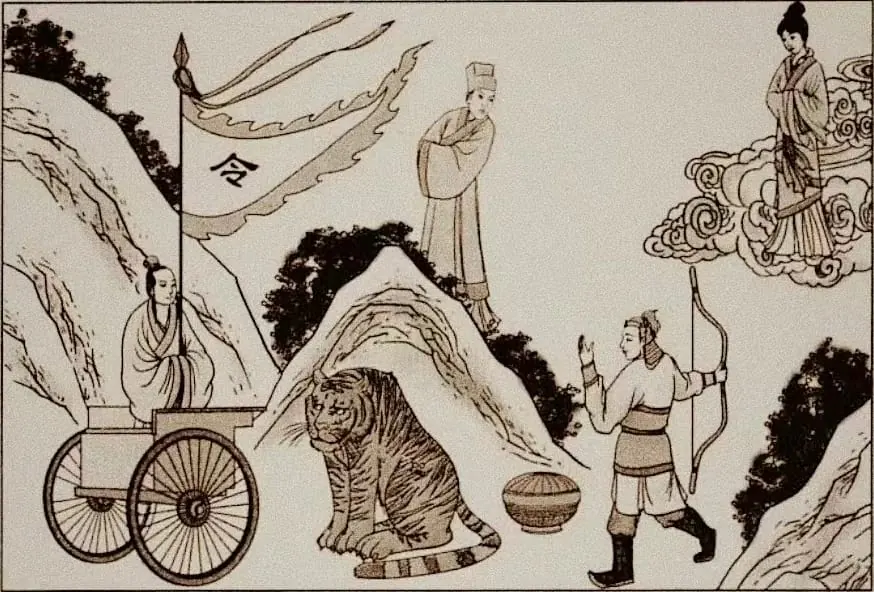
Scene Description
Image Symbolism
Reading the Picture
Lin is approach from above: drawing near to people and affairs while things are rising, and remembering, at the height of growth, that every rise turns.
Begin with the official standing on the ridge in the middle. The Image Symbolism reads a person at the top of the mountain as fullness about to decline: from the summit the only way is down. Below him, at the foot of the hill, sits a tiger, the danger that waits for anyone who descends carelessly. A lidded box sits on the ground nearby, read as something completed first and broken later.
Around this centre are signs of help. On the left a cart flies an envoy’s banner marked 令, command: a mission, and the suggestion that a problem can be solved by negotiation rather than force. At the upper right a woman stands on clouds, riding the wind, read as support arriving from outside. The archer holds his bow upright and does not shoot; the description speaks of shooting, but here the bow is at rest.
The trigrams show the closeness that gives Lin its name: Earth ☷ lies directly above Lake ☱, as near as land to water. The two firm lines at the bottom are just growing, which is why the judgment warns that the eighth month brings misfortune. The figure on the summit illustrates that warning, and the envoy fits the fifth line, the wise ruler who uses the knowledge of others.
- Work
- If you are leading or supervising, consider going closer to the people and work involved. The fifth line favours using others’ wisdom over trying to know everything yourself.
- Relationships
- If you are tempted to win someone over with sweet words, the third line says nothing is gained that way. Ask what genuine care would look like.
- Timing
- Things may be on the rise. If so, this is the moment to plan for the downturn, while there is still time.
Line Statements
Listed from the bottom line to the top line.
- First nine: Approaching together. Steadfastness brings good fortune.
- Nine in the second place: Approaching together. Good fortune; nothing is unfavorable.
- Six in the third place: Sweet-talking approach. Nothing is beneficial. Once concerned about it, no blame.
- Six in the fourth place: Complete approach. No blame.
- Six in the fifth place: Wise approach, fitting for a great ruler. Good fortune.
- Top six: Generous approach. Good fortune, no blame.
Meaning of the Hexagram
Translated from the Chinese 人间道 commentary with AI assistance; translator notes appear in brackets.
“Approach: origin, success, benefit, steadfastness.”
This says that the way of Lin (Approach) can bring great success.
“When the eighth month comes, there will be misfortune.”
The two yang lines have only just been born at the bottom, and the sage warns of it just as they begin to flourish. If, just as things flourish, one considers their decline, one can guard against complacency and plan for permanence; to take warning only after decline has set in is too late. This is the way of guarding against fullness.
People today grow arrogant when they become rich; for the sake of ease and pleasure they ruin the bonds of order, and forgetting calamity and disorder they entrust affairs to petty and treacherous people. All this is because they do not know how to guard against fullness.
“Approach: the firm gradually advances and grows; joyful and compliant, the firm is central and finds response. Great success through correctness: this is the way of heaven.”
The firm is central and attains the correct way, and it has the help of those who respond to it, so it can have great success. The way of heaven can transform, nurture and give birth to all things, simply because it is firm and correct, harmonious and compliant. If one approaches affairs, people and the realm by this way, there is nothing that does not have great success.
“When the eighth month comes, there will be misfortune: the decline will not be long in coming.”
This is the sage knowing to take warning in a time of fullness. If one does not become complacent, misfortune will not arrive.
“Above the lake there is earth: Approach. The noble person accordingly is inexhaustible in his thought for teaching, and boundless in embracing and protecting the people.”
Earth and water draw as near as anything can. From this the noble person knows that the way of Approach is to be this close to the people; only so can he teach and guide them. Only with a heart that is generous and tolerant and protects the people can he embrace them broadly and without limit.
“Approaching together. Steadfastness brings good fortune.”
The first is a low, humble position, but it responds to the fourth by the correct way; it is trusted and able to carry out its aims, so there is good fortune.
“Approaching together, steadfastness brings good fortune: its aim is to act correctly.”
The aim of yang firmness lies in acting correctly; the aim is correct.
“Approaching together. Good fortune; nothing is unfavorable.”
The second nine occupies the position of a general. It can approach people and affairs with a heart of yang firmness and has nothing to be ashamed of before others; good fortune, nothing is unfavorable.
“Approaching together, good fortune, nothing is unfavorable: not by obeying orders.”
The second nine responds to the honoured position of the fifth. Because it has the strength of firm virtue and also attains the middle way, this is a mutual response of perfect sincerity, and so it has good fortune; it is not good fortune gained by obeying the orders of the one above.
“Sweet-talking approach. Nothing is beneficial. Once concerned about it, no blame.”
The third is the position of a chief minister, occupied by a soft yin line. It occupies a high position yet does not approach those below with centrality and correctness; this is a loss of virtue and is not beneficial. If it can be concerned about this and correct it at once, there will be no disaster.
“Sweet-talking approach: the position is not appropriate. Once concerned about it, the blame does not last.”
A soft yin person who does not deal with people and affairs with centrality and correctness, and who sits at the top of the lower trigram, does not suit his position. If he can feel fear and be concerned about it, he will surely correct himself, and his disaster will not last long.
“Complete approach. No blame.”
This is approach at its utmost. The way of Approach arises from nearness. This position is at the bottom of the upper trigram and closely approaches those below; it is the position of a minister close to the ruler. Keeping to correctness and employing worthy people, as if personally approaching those below, there is no blame.
“Complete approach, no blame: the position is appropriate.”
As a minister close to the ruler, it meets its position with yin softness, which is the correct way, and it responds to the firm and worthy one below, so there can be no blame.
“Wise approach, fitting for a great ruler. Good fortune.”
With one person’s body a ruler presides over the breadth of the realm. If he relies on himself for everything, he will certainly be unable to attend to all affairs; to consider oneself all-knowing is precisely to show that one does not know.
Only one who can gather the good of the realm and use the wisdom of the realm leaves nothing unattended. This is not regarding oneself as all-knowing, and so one’s wisdom can become great.
“Fitting for a great ruler: this means acting by the middle way.”
Ruler and minister unite in the way because those of the same spirit seek each other. If the ruler can rely on the firm and central worthy, he can accomplish the work of Approach; this is the meaning of wise approach.
“Generous approach. Good fortune, no blame.”
This is the extreme position of Approach, occupied with the compliance of Kun. It means being honoured yet responding to the humble, being high yet following those below, honouring the worthy and taking up what is good; this is the utmost of generosity. Because it can be generous in complying with the firm, there is good fortune and no disaster.
“The good fortune of generous approach: its aim is directed within.”
Its inner heart is generous, sincere and solid, and its aim complies with yang firmness; that there is good fortune can be known.
Show the Chinese original (人间道)
临:元,亨,利,贞。 言临之道,可致大亨也。 至于八月有凶。 二阳才刚生于下,圣人戒之于方盛,方盛而虑衰,则可以防自满,图其永久,衰而后戒, 无及也,此乃戒盛之道。今人富而多骄,为安乐而坏纲纪,忘祸乱而任小人奸邪,皆因不知戒 盛。
临,刚浸而长,说而顺,刚中而应,大亨以正,天之道也。 刚中得正道,而有应助,故能大亨。天道,能化育生万物,皆因其刚正而和顺而已。以此 道来临事,临人,临天下,莫不大亨通也。 至于八月有凶,消不久也。 此乃圣人知戒于盛时,不以自满,则凶不至也。
泽上有地,临。君子以敎思无穷,容保民无疆。 地与水之临近为至近,君子以此知临之道乃亲民如此,才能教导人民。有宽容保民之心, 才能广大无穷的包容。
咸临,贞吉。 初为卑下之位,而以正道与四位感应,为 所信任而得行其志,故吉。
咸临贞吉,志行正也。 阳刚之志在于行正,志正也。
咸临,吉无不利。 九二居将位,能以阳刚之心临人,临事, 不愧于人,吉无不利。
咸临,吉无不利,未顺命也。 九二乃应于五之尊位,因以刚德之长,又 得中道,此至诚相感,而得吉,并非因顺上之 命而得吉也。
甘临,无攸利,既忧之,无 咎。 三居相位,柔阴居之,此居上位又不以中 正临下,此失德也,不利。如能忧于此而立改 之,则无灾也。
甘临,位不当也,既忧之, 咎不长也。 阴柔之人,处临人事不以中正,又居下之 上,乃不适其位,如能知惧而忧之,则必自改 其灾不长也。
至临,无咎。 此临之至也,临道乃由近而生,此位居上 之下,又切临于下,乃处近君之臣位,守正任 贤,如亲临于下,则无咎。
至临无咎,位当也。 居近君之臣,阴柔对之,为得正道,与下 之刚贤相应,故能无咎。
知临,大君之宜,吉。 以一人之身,君临天下之广,若皆以自任, 必不能周于万事,如自认为皆知者,正明示其 不知也。唯有能得天下之善,用天下之智者, 则无所不周,这就是不以自认皆知,故其知乃 可大。
大君之宜,行中之谓也。 君臣合道,皆因同气相求,君能倚任刚中 之贤,则能成临之功,此知临之意。
敦临,吉,无咎。 此位乃临之极位,以坤顺而居此位,乃意 尊而应卑,高而从下,尊贤取善,此为敦厚之 极也。皆因其能敦厚于顺刚,是以吉而无灾。
敦临之吉,志在内也。 内心敦厚笃实,志顺于阳刚,其吉可知。