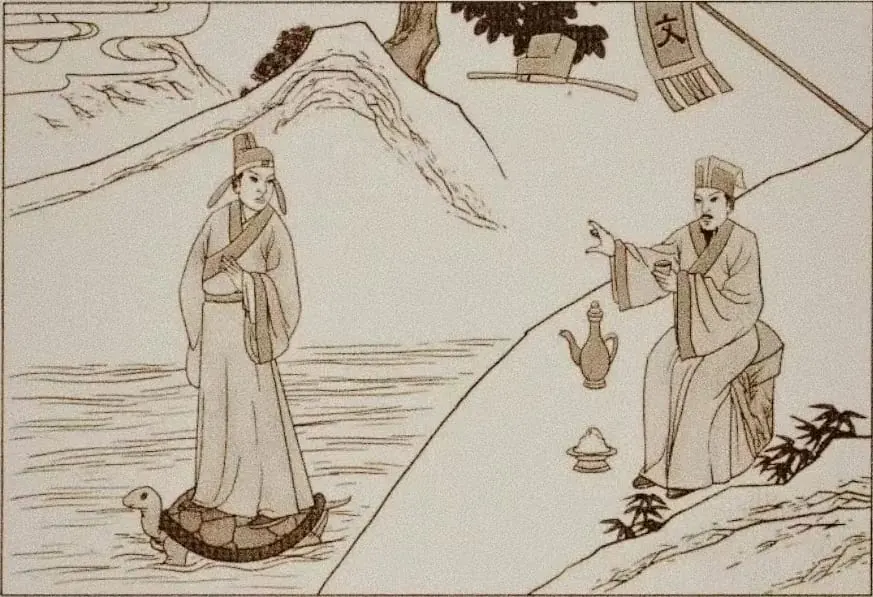
Scene Description
Image Symbolism
Reading the Picture
Dun is retreat at the right time: stepping back while you still can, so that what you stand for is kept whole. The picture is full of quiet signs of leaving.
Look first at the tree along the top edge, where an official’s cap hangs from a branch. Hanging up one’s cap is an old image of resigning office. Below, a man sits alone with a wine jug, cup and dish: rest, nothing pressing, a wish to withdraw. Above him a flag bears the character 文; wine lets worries go, and writing on a flag is read as being helped along by others.
On the left an official stands on a turtle’s back in the water. The Image Symbolism links the turtle, 龟 guī, with 归 guī, going home, and reads the figure at the water as someone waiting for safety. In the upper corner a half moon slips behind cloud: things are half clear, half murky.
The trigrams are Heaven ☰ above Mountain ☶: the mountain rises, heaven draws away. The two figures echo that parting, one on the water, one settled on the hill. The seated drinker fits the fourth line, willing retreat, where the noble person lets go without second thoughts; the hanging cap points to the top line’s abundant retreat, leaving with nothing tying you down.
- Work
- If influence is shifting toward people you cannot work with, consider whether a measured step back protects your aims better. Keep your distance with dignity, not hostility.
- Relationships
- If you feel tied down, ask which ties are real duties and which only slow you. Leaving gracefully is not the same as abandoning someone.
- Timing
- The picture favours withdrawal and small gains over great undertakings. If things are half clear, consider watching a while before committing.
Line Statements
Listed from the bottom line to the top line.
- First six: Retreat at the tail. Danger. Do not go anywhere.
- Six in the second place: Held with yellow oxhide, none can loosen it.
- Nine in the third place: Bound in retreat. Illness and danger. Keeping servants and concubines is fortunate.
- Nine in the fourth place: Willing retreat. Good fortune for the noble person, not for the petty person.
- Nine in the fifth place: Admirable retreat. Steadfastness brings good fortune.
- Top nine: Abundant retreat. Nothing is unfavorable.
Meaning of the Hexagram
Translated from the Chinese 人间道 commentary with AI assistance; translator notes appear in brackets.
“Dun: success; small benefit in steadfastness.”
Dun (Retreat) is the time when the noble person withdraws and conceals himself. The noble person retreats so that his way may extend; if the person retreats but his way does not bend, there can be success. Though there is no great strength, there is still small good fortune, because he knows to withdraw in time; this is the way of goodness.
“Dun, success: it is by retreating that there is success. The firm is in its proper place and responds; it moves with the time.”
The noble person’s way of handling retreat is to know that retreating brings good fortune, and that retreating is the means by which his way is extended. So although it is a time of retreat, the noble person in it does not necessarily truly withdraw. He should follow the waxing and waning of the times; where there is something he can apply his strength to, he should not avoid it, but should support his way. It does not mean hiding away and doing nothing in a time of retreat.
“Small benefit in steadfastness: it gradually grows. Great indeed is the meaning of the time of Dun!”
When the way of the petty person is growing, one cannot seek great achievements, but small achievements are beneficial. The noble person can perceive the subtle signs and from the very start takes deep warning: he retreats so that his way may extend and does not let it dwindle. This is where the great meaning of the time of Dun lies.
“Under heaven there is a mountain: Retreat. The noble person accordingly keeps petty people at a distance, not with hatred but with dignity.”
The mountain is under heaven; it rises from below and stops above, while heaven moves upward [the source’s wording here, 天上进分之相违, is garbled], so the two part from each other. This is the image of Dun: because there is discord, one must withdraw.
In the noble person’s way of keeping petty people at a distance, harsh words and an angry face only increase their resentment. Only by a grave and dignified bearing that makes them respectful and wary will petty people naturally keep away.
“Retreat at the tail. Danger. Do not go anywhere.”
Since Dun itself means going away, the first line, at the start of going back, is instead its tail. At this time, being soft in a time of retreat, one must not go; going brings harm.
“The danger of retreat at the tail: if one does not go, what harm can there be?”
In a time of retreat, to be at the tail is dangerous. Only by staying hidden below, at the end, can one obtain good fortune. Since going brings regret [the source writes 晦, apparently for 悔], it is better not to go; so by keeping hidden one can avoid harm.
“Held with yellow oxhide, none can loosen it.”
The second and fifth positions respond to each other; both are correctly placed and draw close in harmony. Their bond is as firm as if tied with oxhide, beyond what words can say.
“Held with yellow oxhide: the will is firm.”
The second and fifth are joined through the central and correct way and hold to their will with a firm heart, as firm as oxhide.
“Bound in retreat. Illness and danger. Keeping servants and concubines is fortunate.”
In the way of retreat, what matters is to go quickly and far. If one is tied down by affairs, one cannot be quick, and in a time of retreat there is danger.
This line says: as for those close to a person, speaking of women and petty people, they all cherish favours but do not understand what is right. If you treat them with affection they are loyal; if they make a mistake and you are stern with them, they will harm you in secret. This is the way of petty people. But the noble person’s way is not like this: he treats them with correctness, so even if they are a burden there is no harm. Just so, when a king is in danger but does not abandon the common people, though he is in danger there can be no blame; there are many such precedents from ancient times.
“The danger of being bound in retreat: there is illness and exhaustion. Keeping servants and concubines is fortunate: one cannot undertake great affairs.”
The way of bound retreat can be fortunate in keeping servants, concubines and intimates, but it cannot take on great affairs. If one treats people by the central and correct way, without favouritism born of private feelings, and acts from public-mindedness, then great affairs can be undertaken.
“Willing retreat. Good fortune for the noble person, not for the petty person.”
The noble person also has things he loves, but in a time of retreat he will surely leave without hesitation, using the way to govern his desires; so there is good fortune. The petty person is the opposite: he cannot handle it by what is right and follows only what his private desires love, and even when he is trapped he cannot restrain himself; so for the petty person it is not so. Hence the noble person always finds it easy to leave and hard to advance, while the petty person finds it easy to advance and hard to leave.
“The noble person retreats willingly; the petty person does not.”
The noble person knows the time and retreats without hesitation; the petty person cannot restrain his private desires, and so comes to misfortune.
“Admirable retreat. Steadfastness brings good fortune.”
The ruler occupies the middle way; in action and in rest he always follows the time, so it is admirable and ends in good fortune. People today, however, act and rest according to private desire; their outside does not match their inside, they do not act by the central and correct way, and they know how to advance but not how to retreat. This is misfortune.
“Admirable retreat, steadfastness brings good fortune: because the will is correct.”
When the heart within is correct, action is surely correct; this is the beauty of retreat. People today do not see retreat as admirable and are moved only by desire, because their will is not correct.
“Abundant retreat. Nothing is unfavorable.”
This is retreat at its utmost: retreating far and without burdening others. This is retreat with room to spare, and nothing is unfavorable wherever one goes. People today, even when they retreat, still pursue things that entangle others; their actions are not correct and only bring suffering on themselves. This is the burden petty people bring upon themselves.
“Abundant retreat, nothing is unfavorable: there is nothing to doubt.”
To retreat far and with no entanglements is the utmost of the way of retreat, and there is surely nothing unfavorable. Moreover it is firm and decisive, without hesitation. In the noble person’s way of retreat, although he withdraws, because he has the way he can go anywhere without disadvantage.
Show the Chinese original (人间道)
递:亨,小利贞。 遯,乃君子潜藏之时,君子退而伸其道,人退道不屈,则可亨,虽无大力,但仍有小吉, 因知时避退,此善之道也。
遯 遯 遯 遯亨,遯 遯 遯 遯而亨也。刚当位而应,与时行也。 君子处遯之道,知退生吉,退所以为伸道。故虽退之时,君子处之,未必真遯,当随时消 息,有可以致力,当不避之,以扶持其道,并非于遯时,藏而不为也。 小利贞,浸而长也,遯 遯 遯 遯之时义大矣哉! 小人之道长时,不可求大功,但利于小功,君子之人能察于其微,始即深以戒之,退而伸 道,不使道消,此处遯之时意义之大处也。
天下有山,遯 遯 遯 遯;君子以远小人,不恶而严。 山在天下,由下起而上止,天上进分之相违,此遯之象,因违和而须遯。君子远小人之道, 若以恶声厉色,只增其怨忿而已,唯用庄严威色,使其敬畏,小人自然远矣。
遯 遯 遯 遯尾,厉,勿用有攸往。 因遯本即退去,故初爻为往退之初,反为 其尾,此时以柔处遯,不可往,往则有灾。
遯 遯 遯 遯尾之厉,不往何灾也。 退处之时,居于尾者,此危也,唯晦藏于 下或末端,可得吉,因往有晦不若不往,故晦 藏可免灾也。
执之用黄牛之革,莫之胜 说。 二与五位相应,居正而相亲合,其交之坚, 若牛革之繋,不可言语。
执用黄牛,固志也。
二与五位用中正之道相结,且坚心其志, 犹牛革之坚也。
系遯 遯 遯 遯,有疾厉,畜臣妾,吉。 遯退之道,其贵在速及远,如有事累,则 不速,于遯时则有危也。此爻即言,人之亲, 若以女子小人而言,其皆怀恩而不知义,亲爱 之则忠,犯错而严厉时,则生暗害,此小人之 道。然君子之道非如是,待之以正,即令有拖 累亦不有灾,如君王有危而不弃黎民,虽危亦
可无咎,古之前例多矣。
系遯 遯 遯 遯之厉,有疾惫也,畜臣 妾吉,不可大事也。 系遯之道,于养臣妾亲暱人时可吉,但不 可以担当大事,待人取中正之道,不以私心而 生偏,取诸于公,则可行大事矣。
好遯 遯 遯 遯,君子吉,小人否。 君子之人亦有所好,处退之时,必去而不 疑,以道来制欲,故为吉,而小人反之,其不 能以义处之,唯私欲之所好,即令身陷亦不能 自制,故于小人则否。故君子必易出难进,小 人则易进难出。
君子好遯 遯 遯 遯,小人否也。 君子知时而退不疑,小人则无法克制私 欲,以至于凶也。
嘉遯 遯 遯 遯,贞吉。 君王处得中道,动静间必以时,故嘉美, 终吉。今人却动静皆以私欲,表里不一,不以 中正之道处,知进不知退,此凶也。
嘉遯 遯 遯 遯贞吉,以正志也。 内心正则动必正,此退之美也,今人不以 退为美,只动之以欲,因志不正也。
肥遯 遯 遯 遯,无不利。 此退之极致,退求远且无累于他人,此退 之有余,无往不利矣。今人即令退,亦追求有 所牵累他人,其动不正,唯自苦而已,小人自 招之累也。
肥遯 遯 遯 遯无不利,无所疑也。 退之求其远,且无所拖累,此退之道至极, 必无不利。且刚决而不疑,君子之遯道,虽退, 因得道,却能无往不利。