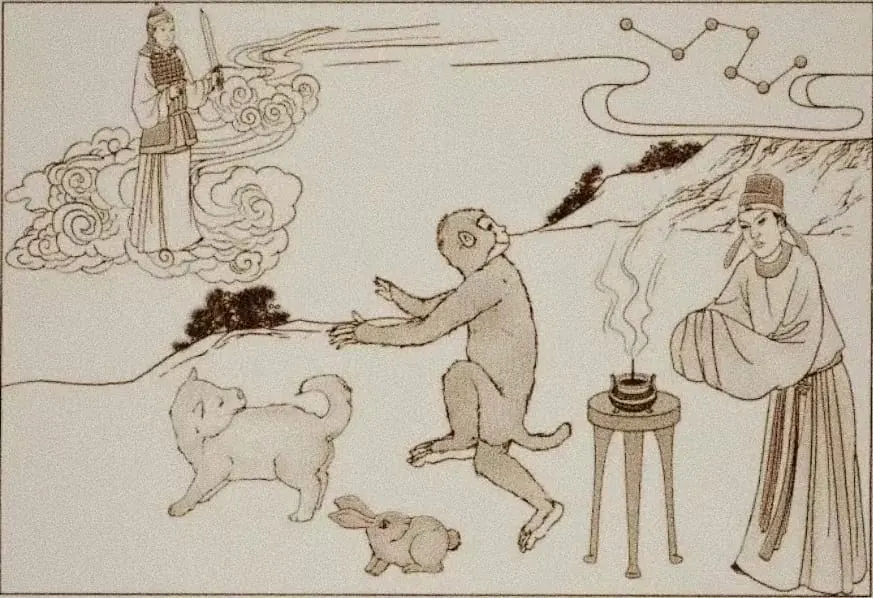
Scene Description
Image Symbolism
Reading the Picture
Da Zhuang is strength at full force: energy is high and things are moving, and the question is whether that power is used correctly or simply pushed.
Look up first. At the upper left a heavenly warrior stands on clouds holding a sword upright; at the upper right the seven stars of the Northern Dipper sit in a band of cloud. Power is in the sky, as the trigrams say: Thunder ☳ above Heaven ☰. The Image Symbolism reads the sword-bearer as the people’s will and the Dipper as whoever is in charge.
On the ground, the monkey is the liveliest figure, springing forward on bare feet with arms outstretched: a fitting picture of the first line, “strength in the toes,” eagerness that leaps before the footing is sure. The official on the right does the opposite. He stands quietly by the smoking incense burner, hands folded in his sleeves, like the noble person who does not tread where propriety does not lead, though the source adds a caution: asking Heaven for help while not turning to people is unfavorable. The lines speak of a ram caught in a hedge, but no sheep is drawn. The scene’s lesson matches the fifth line: too much firmness invites trouble; harmony and ease win more.
- Work
- If you have momentum, consider whether you are aiming it at the right target or pushing simply because you can. Strength used with restraint and allies goes further than force alone.
- Relationships
- If you find yourself insisting, ask whether you are butting a hedge. Gentleness and ease may settle what pressure cannot.
- Timing
- The first and top lines both warn against pushing too far. If you feel stuck between advancing and retreating, pause, soften, and look for the correct path rather than the forceful one.
Line Statements
Listed from the bottom line to the top line.
- First nine: Strength in the toes. Going forward is inauspicious, with certainty.
- Nine in the second place: Steadfastness brings good fortune.
- Nine in the third place: Petty people use strength; noble people use restraint. Steadfastness is dangerous. A ram butts a hedge and entangles its horns.
- Nine in the fourth place: Steadfastness brings good fortune and regret vanishes. The hedge breaks without entanglement; strength in the great wagon's axle.
- Six in the fifth place: Losing the sheep in ease. No regret.
- Top six: A ram butts a hedge, unable to retreat or advance. Nothing is beneficial. Hardship brings good fortune.
Meaning of the Hexagram
Translated from the Chinese 人间道 commentary with AI assistance; translator notes appear in brackets.
“Da Zhuang: beneficial; steadfast.”
The way of Da Zhuang (Great Power) is beneficial in being correct: when the principle is correct, the force is correct. To be strong without being correct is merely force and ferocity without reason; it is not the strength of the noble person.
“Da Zhuang: the great is strong. Firm, and so it moves; hence strength.”
Great and strong together make Great Power. Qian (The Creative), supremely firm, is set in motion: moving outwardly and firm inwardly. This condition is called strength.
“Da Zhuang: it is beneficial to be steadfast: the great is correct. Being correct and great, the nature of Heaven and Earth can be seen.”
The way of Heaven and Earth can keep moving and endure only because it is supremely great and supremely correct; that is how this way can be so supremely great.
“Thunder above Heaven: Great Power. The noble person accordingly does not tread where propriety does not lead.”
The noble person observes the shaking might of thunder in the sky and how great its strength is. In practising the way of Great Power, he knows that nothing is greater than overcoming oneself and returning to propriety. The person who can master himself is the strongest in all of Heaven and Earth; to be able to walk into boiling water and through fire is merely the courage of a warrior. The noble person is harmonious without drifting with the crowd, and stands great without leaning to either side.
“Strength in the toes. Going forward is inauspicious, with certainty.”
The first line is at the bottom, occupied by yang firmness: using strength at the first step forward, which is bound to bring misfortune. Even in a high position, strength must be correct before we act; to be forceful at the very first step surely invites misfortune and humiliation.
“Strength in the toes: its certainty leads to exhaustion.”
To use strength in a low position, even if one’s conduct is trustworthy, will surely bring hardship and obstruction.
“Steadfastness brings good fortune.”
The second place is a yin position, and yang firmness occupies it; this shows people firmness and softness balanced in the centre. If a person can recognize what weighs more and what less in the meaning of the time, there will surely be good fortune.
“The nine in the second place: steadfastness brings good fortune, because it is central.”
To attain centrality and correctness and hold to them firmly: is that not fortunate? This means being central without losing correctness. People today stay neutral for their own advantage and have already lost the correct way, like grass on top of a wall that bends whichever way the wind blows. How lamentable!
“Petty people use strength; noble people use restraint. Steadfastness is dangerous. A ram butts a hedge and entangles its horns.”
Petty people prize force and use only their strength and daring. The noble person ‘uses 罔’ [here read as disregard]: because his will is firm, he pays no heed to what is not correct and is not intimidated by anything. All things use their strength, just as a ram’s strength lies in its head and horns; yet once it meets a hedge, it too is trapped. Therefore in using strength one must not force one’s way forward; one must hold to the correct way and not be intimidated by wickedness and meanness. Only that is true 罔.
“Petty people use strength; the noble person uses restraint.”
Petty people use their powerful force and in the end are trapped. The noble person’s will is firm and strong; he disregards evil and is not intimidated by anything.
“Steadfastness brings good fortune and regret vanishes. The hedge breaks without entanglement; strength in the great wagon’s axle.”
At a time when the way is at the height of its growth, even a small lapse will surely harm the momentum of advance. It is like a great wagon: its axle must be strong for it to travel well, and if the axle is not strong the great wagon cannot move. [With a strong axle] it is like a hedge that has broken open, so that one is not trapped again.
“The hedge breaks without entanglement: it values going forward.”
The fourth place has not yet reached the extreme. It is yang at its height, and it uses strength to advance; nothing can stop it, and even a hedge in the way cannot trap its power.
“Losing the sheep in ease. No regret.”
It is the nature of sheep to like moving in flocks and to butt one another with their horns, just as the yang lines advance together. If one tries to control them by force, it will surely be hard to prevail, and there will be regret. Only by winning them through calm and harmony is there no need to use firmness; letting their strength dissolve in the way of harmony and ease, one can be without regret.
“Losing the sheep in ease: the position is not appropriate.”
A soft line occupies the place of honour; the position is not appropriate. It is like a ruler whose power is insufficient while those below advance in strength; only then does there arise what is called ‘the way of governing strength.’ The way of governing strength cannot use firmness; one must treat people calmly and approachably, and then strength can be transformed.
“A ram butts a hedge, unable to retreat or advance. Nothing is beneficial. Hardship brings good fortune.”
Yin and soft, it also stands at the extreme of strength, like a ram whose horns butt a hedge: it can neither advance nor retreat and has nowhere at all to go. When yin softness finds itself in a time of strength, once it meets hardship it surely cannot hold out, and going forward means misfortune. In times of hardship we must conduct ourselves with softness; then there will surely be good fortune. This is the extreme of strength, where the meaning must change.
“Unable to retreat or advance: this is from lack of careful thought. Hardship brings good fortune: the fault does not last long.”
This comes from conducting oneself without careful thought and caution, so that one can neither advance nor retreat. If one stays soft in a time of hardship, even if there is fault it will not last long.
Show the Chinese original (人间道)
大壮:利,贞。 大壮之道利在正,理正而势正,如不得正而壮,只强猛无理而已,非君子之壮。
大壮,大者壮也,刚以动,故壮。 大且壮为大壮,干之至刚而动,外动内刚状,名壮。 大壮利贞,大者正也。正大而天地之情可见矣。 天地之道可运行而长久,乃至大至正始然也,此道之至大能如是。
雷在天上,大壮,君子以非礼弗履。 君子观雷震威在天,此之壮大,而行大壮之道,知唯克己复礼最大。能自胜之人为天地之 最壮者,能赴汤蹈火,此唯武夫之勇也。君子能和而不流,大立而不倚。
壮于趾,征凶,有孚。 初爻在下,而阳刚居之,乃初进而用壮, 必凶,吾人居上用壮,犹须正方可行,初进而 刚壮,必招凶辱。
壮于趾,其孚穷也。 在下位而用壮,即令行可信,亦必招穷困 阻滞也。
贞吉。 二位属阴位,阳刚居之,乃示人刚柔得中 也,人能识得时义之轻重,则必吉。
九二贞吉,以中也。 能得中正,而坚持守之,也吉乎,此意中 而不失正。今人中立而为己,已失正道,犹墙 头之草,可叹也。
小人用壮,君子用罔。贞厉, 羝羊触藩,羸其角。 小人尚力,只用其壮勇,而君子用罔,因 其志刚,无视于非正之事,无所忌惮也。万物 莫不用其壮,犹羊之壮于首角,一遇藩篱,亦 受困也,故用壮,不可强力进,须持之正道, 无忌惮于邪吝,方为真罔。
小人用壮,君子罔也。
小人用其强壮之武力,终困,君子志气刚 强,无视邪恶,无所忌惮。
贞吉,悔亡,藩决不羸,壮 于大舆之复。 时方道之长盛时,如有小失,则必害进之 势,犹大车其轮轴必壮,乃利于行,如轮轴不 强,以致大车之不行也,有如藩篱之决开而不 复其困也。
藩决不羸,尚往也。
四位未至极,以当盛之阳,又用壮以进, 无能阻之,即令藩篱隔而不困其力也。
丧羊于易,无悔。 羊性喜群行又互触其角,犹诸阳并行,如 以力制,则必难胜有悔,唯其平和得之,则无 所用其刚,使其壮失于和易之道,可以无悔。
丧羊于易,位不当也。 柔居尊位,位不当也,犹人君之势不足, 下又壮进,才有所谓『治壮之道』,治壮之道 不可用刚,须以平易近人待之,可化壮也。
羝羊触藩,不能退,不能遂, 无攸利,艰则吉。 阴柔又处壮极,犹羊角之触藩,进退不得, 必无所往也,阴柔处壮时,一遇艰困,必不能 守,往即凶也。吾人须居艰困时而处柔,必吉。 此壮之极,须变义也。
不能退,不能遂,不详也。
艰则吉,咎不长也。 此因自处不详不慎,以致进退不能也。以 柔处艰时,即有咎,亦不长久。