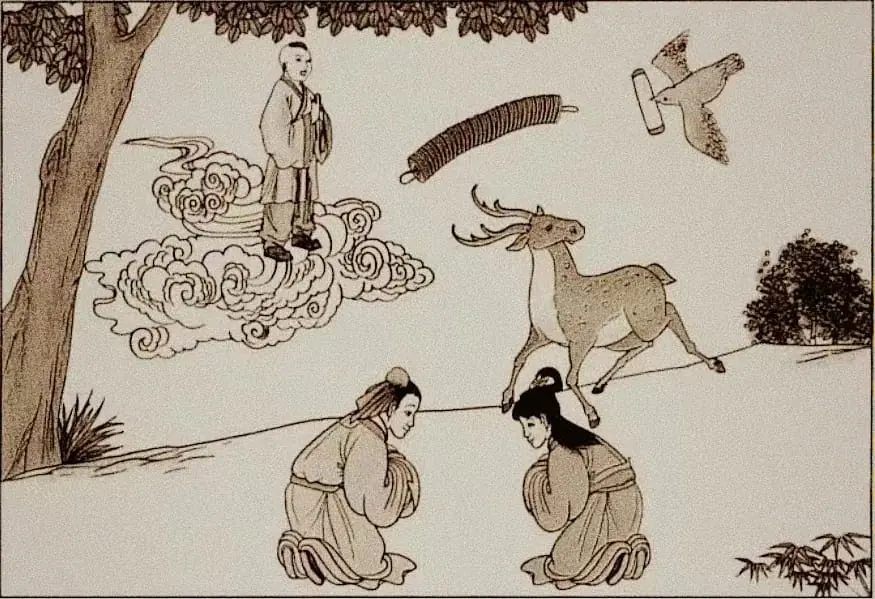
Scene Description
Image Symbolism
Reading the Picture
Gu is the work of repairing what has been allowed to spoil: old troubles inherited from before, which can be set right if you look at their roots and think ahead.
The title calls this the lesson of “three gu eating blood”: the old character 蠱 shows worms in a vessel, something left until it rots. On the clouds at the left stands a child, whom the Image Symbolism reads as help from above and as someone who does not chase fame or gain. In the sky a bird brings a letter, news arriving, and a string of coins floats in mid-air: profit on the mind rather than in hand.
Below, a deer bounds across the slope (鹿 lù, echoing 禄 lù, reward), and in front of it a man and a woman kneel and bow to each other. The source reads this as a union in which gain weighs heavily.
The trigrams explain the decay: Wind ☴ blows beneath Mountain ☶, turns back and scatters things into disorder. The repairs fall to the next generation, as the lines on correcting a father’s and a mother’s affairs show. The child on the cloud fits the top line: not serving kings or lords, holding one’s own work in high esteem.
- Work
- If you inherit a project that has gone wrong, consider spending time on its causes before you fix it, and on what will keep it from spoiling again.
- Relationships
- If a bond seems to rest on what each side gains, ask what it rests on beyond that. With elders, the second line advises gentleness over rigid correction.
- Timing
- The judgment speaks of three days before and three days after jia, the start of a cycle. Before a fresh start, prepare; after it, review.
Line Statements
Listed from the bottom line to the top line.
- First six: Correcting the father's corruption. When there is a son, the late father incurs no blame. Danger, but good fortune in the end.
- Nine in the second place: Correcting the mother's disorder. One must not be rigidly steadfast.
- Nine in the third place: Correcting the father's disorder. Some regret, no great blame.
- Six in the fourth place: Indulging the father's disorder. Going forward reveals regret.
- Six in the fifth place: Correcting the father's disorder wins praise.
- Top nine: Not serving kings or lords; holding one's work in high esteem.
Meaning of the Hexagram
Translated from the Chinese 人间道 commentary with AI assistance; translator notes appear in brackets.
“Work on What Is Spoiled: supreme success. It is beneficial to cross the great river.”
The greatness of Gu (Work on What Is Spoiled) lies in the hardship and danger of the times. If there is someone with the ability to set right what is spoiled, there will surely be success.
“Three days before jia, three days after jia.”
Jia is the first of the ten heavenly stems, meaning the beginning of affairs. “Three days before jia” speaks of the way of setting right what is spoiled: one should first consider the origin of the matter, and then consider what will follow it; then one knows how to remedy the abuse. It also stresses thinking deeply and projecting far ahead. One who is good at remedying can reform the abuses of the past; one who is good at preparing ensures lasting benefit afterwards. This is the sage’s way of dealing with what is spoiled.
People today do not understand the sage’s warning of “before jia and after jia.” Their thinking is shallow and their view short, so they toil at rescuing disorder, yet the disorder is not reformed; before their work is complete, new abuses have already arisen.
“Work on What Is Spoiled: the firm is above and the soft below; gentle and still: Work on What Is Spoiled.”
In terms of the hexagram, the male, though young, is above, and the female, though elder, is below. Honoured and humble are in their correct places, and above and below accord with principle; this is the way of setting right what is spoiled. So one deals with what is spoiled through the way of gentle compliance, and therefore there is supreme success.
“Work on What Is Spoiled, supreme success: and the realm is well governed. It is beneficial to cross the great river: going forward, there is work to do.”
Since antiquity, those who brought order out of disorder have made the proper relations of honoured and humble, above and below, correct: those below are gentle and compliant, and those above have the ability to settle all affairs. In this way the realm is greatly governed. If one meets a time when the realm is in ruin and disorder, it is beneficial to go forth and help it with the way of setting right what is spoiled.
“Three days before jia, three days after jia: where there is an end, there is a beginning. This is the movement of heaven.”
Where there is a beginning there must be an end, and after an end there must be a beginning; this is the way of heaven. The sage embodies the way of beginning and end, so at the start of an affair he can investigate why it is so, and at its end he can prepare for what is to come. This is the forethought of “before jia and after jia,” and so he can set right what is spoiled and the realm has success.
“Below the mountain there is wind: Work on What Is Spoiled. The noble person accordingly stirs up the people and nurtures virtue.”
There is wind below the mountain: when the wind meets the mountain it turns back, so that things are all scattered in disorder; hence it is the image of there being work to do. The noble person observes this image: for himself, he cultivates virtue; for the realm, he helps the people. Of all the noble person’s work, these two are the greatest.
“Correcting the father’s disorder. Having a son, the deceased father incurs no blame. Danger, but good fortune in the end.”
The way of the common people is the way of a son setting right his father’s spoiled affairs. If the son can occupy his place and know what is correct, there is no disaster; otherwise he becomes a burden to his father. So he must be watchful and cautious, and in the end there is good fortune. The first six is the lowest position, so it speaks of the relationship between son and father.
“Correcting the father’s disorder: the intention is to carry on for the deceased father.”
The way of a son setting right his father’s spoiled affairs lies in being able to take on his father’s work. If he is always watchful and cautious, simply attends reverently to the work and is wholly sincere towards his father, there will be good fortune in the end.
“Correcting the mother’s disorder. One must not be rigidly steadfast.”
A woman is by nature yin and soft. If the son only insists on asserting his own yang firmness and opposes her, he will wound the bond of affection, and the harm is great. He can only bend his own will and yield and comply to bring things about, so that she herself becomes upright and the matter is put in order. Hence “one must not be rigidly steadfast.”
It is like using the way of yang firmness to assist a soft and weak ruler: one must be wholly sincere and exhaust one’s loyalty to bring him to the middle way, and that is enough; there will be no great undertakings.
“Correcting the mother’s disorder: one attains the middle way.”
Occupying the position of a subject and not being overly firm, one attains the complete way of setting right the mother’s spoiled affairs.
“Correcting the father’s disorder. Some regret, no great blame.”
The third nine, with the ability of yang firmness, occupies the position of a chief minister and does his work to the full. Although there is some regret because his firmness is excessive, in the end there is no great disaster. But judged by the way of serving one’s parents, he is not one who serves his parents well.
“Correcting the father’s disorder: in the end there is no blame.”
This is because of an ability that is firm and clear in judgment. Although it is firm, it does not lose correctness, so in the end there is no disaster.
“Indulging the father’s disorder. Going forward reveals regret.”
This is a soft and compliant ability that handles affairs by the correct way, but it can only keep to its own way. If it meets affairs that are not correct, its soft and compliant nature cannot set them right, so it fails and invites dismissal.
“Indulging the father’s disorder: going forward, one does not attain it.”
A soft and compliant ability can hold its ground in easy times, but if it is to move forward, it cannot succeed; and if further tasks are added, it will certainly be unequal to them. The sage knows that a soft and compliant ability can preserve what has been achieved but cannot be used for expansion; if it is entrusted with heavy responsibility, it will surely fail.
“Correcting the father’s disorder wins praise.”
The person in this ruler’s position is soft in nature, but responds below to the second nine, a position of yang firmness, which means he is able to employ a talent of yang firmness as his minister. But because he is fundamentally yin and soft, he can carry on the old inheritance but is not one with the ability to found new undertakings.
Since antiquity, the founding of great undertakings has required firm and clear-sighted ability. One who cannot employ firm and worthy people can only preserve the old ancestral inheritance.
“Correcting the father’s disorder and winning praise: he carries on through virtue.”
A soft, yin ruler is able to receive the yang firmness of those below; because he can make use of the worthy people in lower positions, his reputation becomes illustrious.
“Not serving kings or lords; holding one’s work in high esteem.”
The top nine is at the end of Work on What Is Spoiled, a place where there are no affairs, outside the handling of affairs. This corresponds to a worthy, noble person who does not meet with his time: he should keep himself lofty and pure and must not bend the way to accommodate the times. This is advancing and withdrawing in accord with the way.
“Not serving kings or lords: his resolve can serve as a model.”
He does not serve kings and lords as a subject because he knows he cannot carry out his aims there; this is a worthy and able person, and he can serve as a model. Petty people are all able to bend the way and go along with things, betraying themselves and defying heaven in pursuit of power, fame and position; they cannot be taken as a model.
Show the Chinese original (人间道)
蛊:元亨,利涉大川。 蛊之大者,乃时之艰难险阻,能有治蛊之才,则必亨通。 先甲三日,后甲三日。 甲为十干之首,意言事之始也。先甲三日,乃言治蛊之道,应先思其事之原,再思其事之 后,乃知救弊之道。亦强调虑之深,推之远也。能善于救者,则前之弊可革,能善亲备者,则 后利长久。
此圣人之治蛊道。今人不明圣人先甲后甲之诫,虑浅而事近,故劳于救乱,乱不革, 功未及成,弊已生矣。
蛊,刚上而柔下,巽而止,蛊。 以卦而言,男虽少但居上,女虽长而在下,尊卑得正,上下顺理,治蛊之道也,故以巽顺 之道治蛊,是以元亨。 蛊,元亨,而天下治也。利涉大川,往有事也。 自古治乱者,能使尊卑上下之义正,在下为巽顺,在上有才能安定万事,如此则天下大治。 如正遇天下坏乱之时,持治蛊之道而往济之,利也。
先甲三日。后甲三日,终则有始,天行也。 有始必有终,终之后必有始,此天道也。圣人体始终之道,故能于事之始而探究其所以然, 能于事之终而备其将然,此先甲后甲之虑,故能治蛊而天下亨。
山下有风,蛊,君子以振民育德。 山下有风,风遇山而回,致物皆散乱,故为有事之象。君子观有事之象,在己则养德,在 天下则济民,君子所事此二者为最大。
干父之盎,有子,考无咎, 厉终吉。 庶民之道,即子干父蛊之道。子能居其位 而知正,则无灾,不然,则为父之累,故必惕 厉为戒,终吉。初六为最下之道,故言子与父 之关系。
干父之蛊,意承考也。 子干父蛊之道,意在能承担父事,常怀惕 厉,只敬其事,尽诚于父,则终吉。
干母之蛊,不可贞。 妇人本阴柔,若子只顾强伸己阳刚之道, 反逆之,则伤恩,所害大也,唯有屈下己意柔 顺将成,使之身正而事乃治,故曰不可贞。如 同阳刚之道辅柔弱之君,须尽诚竭忠致使其于 中道即可,不会有大做为的。
干母之蛊,得中道也。 居臣位,不过刚,乃得干母蛊之道完整者。
干父之蛊,小有悔,无大咎。 九三乃以阳刚之才居相位,克尽所事,虽 以刚过而小有悔,但终无大灾,但如以事亲之 道,则并非善事亲之人也。
干父之蛊,终无咎也。 此因刚而明断之才,虽刚因不失正,故终 无灾。
裕父之蛊,往见吝。 此柔顺之才而以正道处事,只能自守其道 而已,若遇非正之事,因柔顺之本质,而无法 矫正,故不能而招罢斥。
裕父之蛊,往未得也。 柔顺之才,守于寛裕之时可以,如要前行, 则不可得也,再加其任务,必不能胜任之。圣 人知柔顺之才可以守成,但不可用于发展,委 之重任,必不成也。
干父之蛊,用誉。 此君位之人但质柔,但下应九二阳刚之 位,意其能用阳刚之才为臣,但因本实阴柔, 故可为承其旧业,而不能为开创事业之才。自 古创业之事,非刚明之才不足以成事。不能用 刚贤之人,只可以守旧袓业而已。
干父用誉,承以德也。 阴柔之君主,能承下阳刚之才,以在下位 之贤而能用之,乃因此而声誉显。
不事王侯,高尚其事。 上九乃居蛊之终,乃无事之地,处事之外。 此应贤人君子不遇于时,应高洁自守,不可曲 道以遁时,此进退合于道者也。
不事王侯,志可则也。 不臣事于王侯,因知无法施其志,此乃贤 能之人,此可以为法则也。小人皆可曲道而顺 行,背己逆天,只图权力名位,此不可法也。