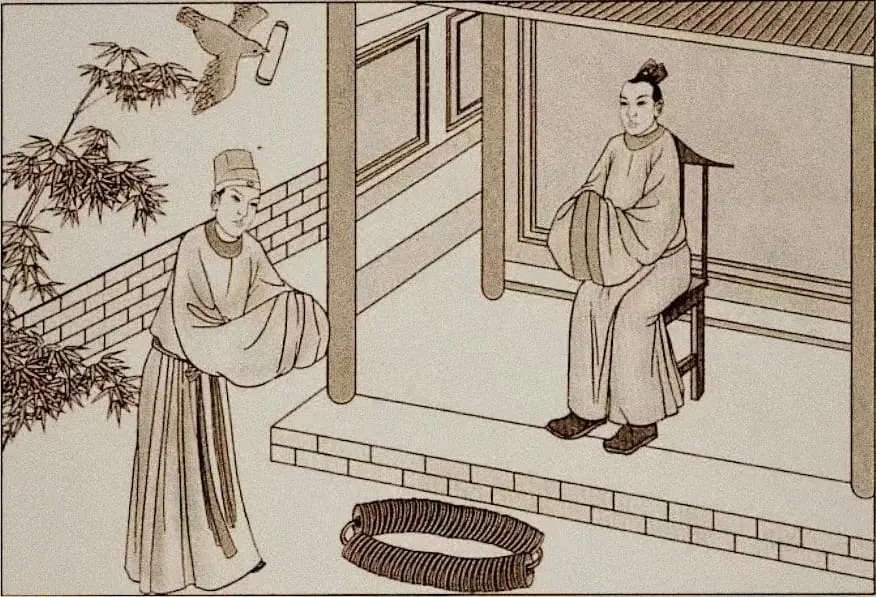
Scene Description
Image Symbolism
Reading the Picture
Sui is following well: knowing whom and what to follow, and when, so that people come together by choice and for the right reasons.
Look first at the bird flying in at the top left with a letter in its beak. The written description calls it a goose bringing a message out of the clouds (no clouds are drawn), and the Image Symbolism reads it as good news on its way. Below it a scholar stands outside the hall, bowing with his hands joined in his sleeves, while a dignified man sits inside under the eaves. The source reads the seated figure as a ruler and the visitor as someone seeking office and being received with respect: courtesy opens the door.
On the ground in front of them lies a coiled heap of coin strings. The source reads gathered coins as wealth coming together, though strings left lying on the ground can also mean profit not yet put to use. The written description adds pearls collected in a basin, gathered and later scattered, but they are not drawn.
The trigrams set the rhythm: Thunder ☳ below, moving, and Lake ☱ above, joyful. Movement that brings joy is the way followers gather. The visitor at the threshold illustrates the first line, going out of the gate to make connections without private motives, and the meeting itself suggests the fifth line, sincerity toward the good.
- Work
- If you are looking for a role or a mentor, consider what you are choosing to follow and why. Approach with courtesy and a clear purpose.
- Relationships
- If you must choose between two people or two loyalties, the second and third lines say you cannot hold both. Ask which bond rests on what is right.
- Timing
- News may be on its way. If things are moving, follow the rhythm of the time: act by day, rest at night, and do not force the pace.
Line Statements
Listed from the bottom line to the top line.
- First nine: An official changes. Steadfastness brings good fortune. Going out and making connections achieves results.
- Six in the second place: Bound to the little boy, losing the grown man.
- Six in the third place: Bound to the grown man, losing the little boy. Following brings what one seeks. It is beneficial to remain steadfast.
- Nine in the fourth place: Following brings gain; steadfastness is inauspicious. With sincerity on the path and clarity, what blame is there?
- Nine in the fifth place: Sincerity toward the good. Good fortune.
- Top six: Seized and bound, then tied fast. The king makes an offering at the western mountain.
Meaning of the Hexagram
Translated from the Chinese 人间道 commentary with AI assistance; translator notes appear in brackets.
“Following: origin, success, benefit, steadfastness. No blame.”
The way of Following can bring about great success. The way of the noble person is what the multitude follows; and when he meets affairs he chooses what to follow. If following accords with the way, it is sure to bring great success.
Now the ruler follows the will of the people, and ministers follow the will of the ruler; everyone follows what is right. The benefit lies in holding firmly to the righteousness of following. Because following can be correct, its way is sure to succeed. When petty people gather in groups, this following loses correctness; how could it not invite misfortune?
“Following: the firm comes and places itself below the soft; movement and joy: Following. Great success and steadfastness, no blame, and all under heaven follows the time.”
Thunder is firm and now sits below the soft: the honoured and noble follow those below; this is the meaning of Following. In the relationship of minister and ruler, the one above is joyful and the one below moves; moving in a way that brings joy is the way of Following. Being like this, there is success and no disaster.
“Great indeed is the meaning of following the time!”
The way of the noble person changes with the time and does what is fitting for the time. The present age is benighted and unclear: everything is bright on the surface and dark underneath. Therefore what the people follow is not well judged; they are often misled by rumours and outward show, so their following is sure to go astray, and they are used by treacherous people.
“Thunder in the midst of the lake: Following. The noble person accordingly goes indoors at nightfall to rest.”
The lake moves in response to the shaking of thunder. By day the noble person strives ceaselessly; at night he goes indoors and settles himself. To rise and rest in accordance with heaven’s times is fitting. The Book of Rites says: “By day the noble person does not stay indoors; by night he does not stay outdoors.” This is the way of following the time.
“An official changes. Steadfastness brings good fortune. Going out and making connections achieves results.”
官 (official) here means what one holds to. Because what one follows is correct, there is good fortune. Going out of the gate, one has dealings with many who are friendly and affectionate, because people’s hearts follow.
It is ordinary human feeling that whatever one loves seems right and whatever one dislikes seems wrong. Petty people all follow out of private feeling, not in accord with right principle. The noble person goes out of the gate and makes connections without selfishness, so all that he follows achieves results.
“An official changes: following what is correct brings good fortune. Going out and making connections achieves results: nothing is lost.”
The way one follows must be correct for there to be good fortune; following what is not correct invites regret and blame. Because one’s connections do not arise from private motives, they are sure to be correct, and so nothing is lost.
“Bound to the little boy, losing the grown man.”
The second six is a soft yin position. Yin means compliance and soft obedience. But if what one complies with and follows is a petty person, one is sure to lose the noble person. This is because one cannot hold firm, and the sage warns against it.
“Bound to the little boy: one cannot be with both.”
When what a person follows is the correct way, evil is sure to keep its distance. But one must take care: if a person follows what is correct, he must be single-minded and cannot hold to both at once.
“Bound to the grown man, losing the little boy. Following brings what one seeks. It is beneficial to remain steadfast.”
The third six occupies the position of a chief minister. It holds firmly to its own correctness and seeks to follow the one above; whatever it seeks it obtains. This is the highest kind of following. To turn one’s back on what is right and seek what is wrong, abandoning the noble person to follow the petty person, is the lowest kind of following. So in the noble person’s following, the first thing is to hold firmly to one’s own correctness.
“Bound to the grown man: the will lets go of what is below.”
The highest good of following lies here: letting go of petty people and following the noble person. If everyone were like this, petty people would have nowhere to hide. If one constantly examines oneself, human nature follows goodness as water flows, and there will be no petty people.
“Following brings gain; steadfastness is inauspicious. With sincerity on the path and clarity, what blame is there?”
The fourth is the highest position of a minister. If following brings gain, even correctness easily invites misfortune, because the hearts of the realm follow oneself. The way of a minister is to let favour and authority come from the one above, so that the hearts of the multitude follow the ruler; to make people’s hearts follow oneself is the way to misfortune. So when the noble person is in this position, he is simply sincere and correct at heart, and all his actions accord with the way; then there can be no regret.
When a petty person reaches the highest position, he uses the king’s power to pursue his own aims; he wins the people’s hearts and does not credit the one above. Reaching the highest position, he presses upon his superior; with his power strong, he monopolises authority. This is following carried much too far. Although the noble person’s merit may be so great that it alarms the ruler, because he is correct and sincere at heart, the ruler follows and trusts him; what disaster could there be?
“Following brings gain: its meaning is misfortune. With sincerity on the path: clarity brings merit.”
In a position close to the ruler, one gains through being followed. Although there is the warning of misfortune, if one has the sincerity of centrality and correctness, there is no disaster: this is wisely keeping oneself safe.
“Sincerity toward the good. Good fortune.”
The person in this ruler’s position attains centrality and correctness and holds to them firmly; in his actions he follows the good, and there is great good fortune. So, from the ruler to the common people, the good fortune of the way of Following lies only in following the good.
“Sincerity toward the good, good fortune: the position is correct and central.”
Occupying the central and correct position, and followed with inner sincerity, there is sure to be good fortune.
“Seized and bound, then tied fast. The king makes an offering at the western mountain.”
This is softness and compliance at the extreme of Following. When compliant following reaches its extreme, there is the fault of excess. But if people’s hearts all follow, then, because one has the following of the people, the work of the kingly way can still be accomplished. So whoever wins the hearts of the people wins the realm.
“Seized and bound: at the top it is exhausted.”
Here the way of Following reaches its end.
Show the Chinese original (人间道)
随:元,亨,利,贞,无咎。 随之道,可以致大亨通。君子之道,众人所随,又遇事择所随,随能得道,必致大亨。今 人君之从民意,臣下之从君意,人人随从义,利在坚守随义,随因能正,其道必亨。小人群聚, 此随失正,岂不招凶乎。
随,刚来而下柔,动而说,随。大亨,贞,无咎,而天下随时。 雷为刚今居柔下,是以尊贵而对下随,为随之义。臣君关系,以上悦下动,以动可悦,为 随之道,如是则亨通而无灾。 随时之义大矣哉。 君子之道,随时而变,因时制宜。今世昏蒙不明,凡事皆表明里暗,是故民之所随,未能 适中,常受謡言、外饰所惑,随而必枉,受奸人利用。
泽中有雷,随,君子以向晦入宴息。 泽随雷震而动,君子昼则自强不息,夜则入居内安其身,起居作息随天时,乃宜也。礼云: 君子昼不居内,夜不居外,此随时之道。
官有渝,贞吉,出门交有功。 官为守也,因所从随为正,故吉。出门交 往多所亲爱者,因人心所从随也。常人之情, 爱之所见皆对,恶之所见皆非,小人皆以私情 而随从之,不合正理,君子出斗交不以私,故 所随皆有功也。
官有渝,从正吉也。出门交 有功,不失也。 所随从之道,须从正则吉。随从不正,招 悔咎也。因交非因本身之私,其交必正,故不 失。
系小子,失丈夫。 六二为阴柔位,阴乃顺从,柔顺之意,但 如顺随的对象为小人,则必失却君子之人,此 因不能固守,圣人戒之。
系小子,弗兼与也。 人因所顺随为正道,邪恶必远也,但须戒, 人若从于正,须专一,不可兼与。
系丈夫,失小子,随有求得, 利居贞。 六三居相位,所固守本身之正,求上之随, 有求必得,乃上上随也。如背是求非,舍君子 从小人,为下下之随也。故君子之随,首先固 守本身之正。
系丈夫,志舍下也。 随之至善即在此,舍小人而从君子,人人 如此,小人无所遁也,常自省而人之性乃从善 如流,故将无小人矣。
随有获,贞凶,有孚在道以 明,何咎? 因四位乃臣之极位,如随而有获,即正亦 易招凶,皆因天下之心随于己。为臣之道,应 使恩威出于上,众心能随于君,如让人心从己, 致凶之道。故君子居此,唯诚正于心,所动皆 合于道,则可无悔。小人位极,用君王权,遂 行其志,得民心又不归功于上,位极而逼上, 势强而专权,随之过大矣。
君子虽功大震主, 但由于其正而心诚,故主随从而信之,何有 灾?
随有获,其义凶也,有孚在 道,明功也。 近君之位,因追随而有得,虽有凶戒,但 有中正之诚,则无灾,明哲保身也。
孚于嘉,吉。 此君位之人,得中正而固守,动随于善, 大吉也。故此,从人君到平民,随道之吉,唯 随善耳。
孚于嘉,吉,位正中也。 处中正之位,又中诚所随,必吉矣。
拘系之,乃从维之,王用亨 于西山。
此柔顺而居随之极也,柔顺之随至极虽有 过之失,但如人心皆随,因有得民之随,仍有 王道王业之成也,故能得民心者,得天下也。
拘系之,上穷也。 随之道至此,乃穷尽也。