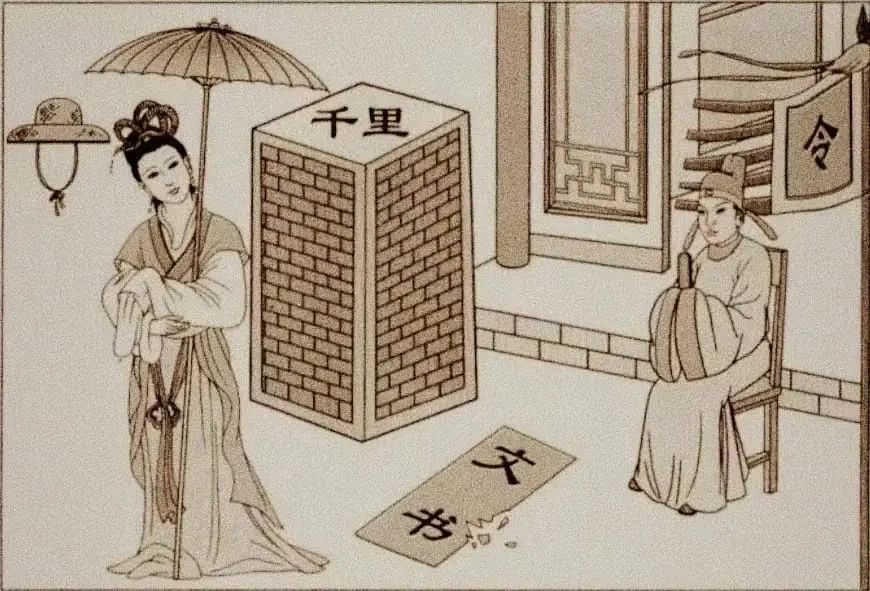
Scene Description
Image Symbolism
Reading the Picture
Lü is treading carefully: walking a path close to danger, like stepping on a tiger’s tail, and coming through unharmed because one’s conduct is proper.
Begin with the woman on the left. She walks under an open umbrella, which the Image Symbolism reads as shelter and protection. A bamboo hat hangs in the air beside her; the description places her beneath it, though the artist has drawn it apart. In the centre stands a brick watch-post inscribed 千里, “a thousand li,” a sign of a long road and, for the symbolism, of rank won far from home. At its foot lies a document marked 文书, torn at one corner: a promise or proof that no longer holds.
On the right an official sits beside a banner bearing 令, “command,” read as lawsuits and authority: the tiger in this picture is the power of office. The description also speaks of two footprints showing a safe passage through danger, but they are not drawn. The trigrams frame the scene: Lake ☱ below is joy and gentleness, Heaven ☰ above is strength. The soft walks behind the strong, as in the Judgment, and is not bitten because it is courteous. The fourth line fits the scene best: close to power, fearful and cautious, and fortunate in the end.
- Work
- If you work close to someone powerful, consider whether your conduct is careful and respectful enough to keep you safe. Check that the papers and promises you rely on are actually sound.
- Relationships
- If a relationship involves an imbalance of strength, ask whether courtesy and honesty are guiding how you step. Gentleness without fear of the other is the ideal here.
- Timing
- Proceed, but step by step. If you feel overconfident, recall the third line: pushing ahead beyond your real ability is how the tiger bites.
Line Statements
Listed from the bottom line to the top line.
- First nine: Go forward with plain conduct. No blame.
- Nine in the second place: Treading a level path. The secluded person's steadfastness brings good fortune.
- Six in the third place: The one-eyed can see and the lame can walk; treading on the tiger's tail, it bites the person. Misfortune. A warrior acts as a great ruler.
- Nine in the fourth place: Treading on the tiger's tail, fearful and wary; good fortune in the end.
- Nine in the fifth place: Resolute treading. Steadfastness is dangerous.
- Top nine: Examine one's conduct and assess the signs. Returning brings great good fortune.
Meaning of the Hexagram
Translated from the Chinese 人间道 commentary with AI assistance; translator notes appear in brackets.
“Treading on the tiger’s tail; it does not bite the person. Success.”
With the way of propriety, even when one enters danger, as when stepping on a tiger’s tail, one is not turned on and devoured, because one has propriety; therefore there is success. As the common saying goes, “No one raises a hand to strike a smiling face”; it is the same idea.
“Lü: the yielding treads upon the firm. Joyful, it responds to Qian; therefore it treads on the tiger’s tail and is not bitten. Success.”
Dui is the lake and joy. Dui, soft and compliant, leans upon the firmness of Qian (The Creative) and responds to it, and also shows propriety from below; so it steps on the tiger’s tail and they do not harm each other.
“Firm, central and correct, it treads the position of the sovereign without fault; it is bright.”
The fifth nine is yang and firm and occupies the ruler’s position, and it also has the excellence of the way of treading. This is why it is without fault, and so it attains brightness.
“Heaven above, the lake below: Treading. The noble person accordingly distinguishes high and low and settles the aims of the people.”
Heaven is above and the lake below; honourable and humble have their places. This is the correct order of the world. Human propriety is always like this; only with propriety can things proceed. Observing the image of Lü, the noble person distinguishes between high and low in order to settle the aims of the people; when the distinction between high and low is clear, the people’s aims are settled, and only then can one speak of good government. If the laws are complicated, the people have nothing to follow, and good government will be no more.
So each person should be at peace in his position; this is attaining what is properly his. If someone occupies a position without advancing in virtue, he should be removed, and the noble person should appoint others. A scholar advances in learning, and when he has reached a certain level the noble person seeks him out. People in every walk of life, scholars, farmers, artisans and merchants, because what they enjoy is limited, can have settled aims, and then the whole realm is of one mind.
People today, from those below up to the high ministers, set their minds every day on honour and glory; farmers, artisans and merchants think every day of wealth and luxury. The hearts of millions of people compete with one another for profit; when the whole realm is like this, how can hearts be of one accord? It would be hard indeed to keep it from disorder! All of this is because above and below have not settled their aims. Observing Lü, the noble person distinguishes high and low and puts each in his proper place, and by this settles the direction of the people’s hearts.
“Go forward with plain conduct. No blame.”
The first line is at the bottom. Its yang firm talent could advance, but outwardly it shows the plain bearing that suits its humble position, and so there is no blame.
“Going forward with plain conduct: alone, it carries out its wish.”
It goes forward content with propriety, because it is not doing so for gain; each has his own aim. If a person has both the wish to practise the Way and the wish for fame and profit, battling within him, how could he tread calmly?
“Treading a level path. The secluded person’s steadfastness brings good fortune.”
The second is a yin position occupied by yang; this means that the propriety with which it treats others is open and broad, the plain and easy way. Because yang is advancing, it must guard against people’s scorn and slander over matters of form [this phrase is garbled in the source]; therefore if it meets this time with a quiet, secluded and tranquil mind, there is good fortune.
“The secluded person’s steadfastness brings good fortune: within, it does not fall into confusion.”
The way of treading (the way of propriety) lies in calm. When its cause is correct, what it treads is safe; if the heart is restless, one cannot rest in the way of propriety. That is, to show propriety to others one must be calm at heart; if desire for gain battles within, one will surely fall into confusion.
“The one-eyed can see and the lame can walk; treading on the tiger’s tail, it bites the person. Misfortune. A warrior acts as a great ruler.”
The third is a yang position occupied by a soft line: its will wants to be firm, but its substance is soft, and it cannot hold firmly to the way of treading. It is like a blind person who looks but does not see, or a lame person who walks but cannot go far: its ability is insufficient, and the times are also against it. So its propriety is not correct, and it treads in a dangerous place. Because it does not tread well, it enters danger and invites misfortune, and disaster comes at once; hence “it bites the person, misfortune.” It is like a violent warrior who sits above others and acts as he pleases without knowing propriety: this is the way to misfortune.
“The one-eyed can see, but not enough to see clearly; the lame can walk, but not enough to keep up.”
Yin softness is a person of insufficient ability, whose sight is unclear and who cannot walk far; now it also sits above the firm, and disaster comes.
“The misfortune of being bitten: its position is not fitting. A warrior acts as a great ruler: its will is firm.”
The cause of this misfortune is insufficient ability. It is compared to a warrior who occupies a firm yang position without sufficient ability and yet forces himself forward; what he treads is not his proper way. This is having a firm will and acting rashly.
“Treading on the tiger’s tail, fearful and cautious; good fortune in the end.”
It is at the ruler’s side and knows that serving a ruler is like keeping company with a tiger. “Fearful and cautious” (愬愬) describes a fearful appearance; the meaning is that if one can be fearful, the end will surely be fortunate. A firm yang line in a high position, though close to the ruler, if it can be reverent, careful and fearful, will surely have good fortune in the end, even when it enters danger.
“Fearful and cautious, good fortune in the end: its will is carried out.”
With a fearful appearance it enters danger and yet ends in good fortune, because its real intention is to carry out its own aims. It must occupy this position in order to carry out its aims, and so it shows a fearful manner; in the end it obtains good fortune, and its aims are carried out.
“Resolute treading. Steadfastness is dangerous.”
Guai (夬) means firm decisiveness. Although the fifth nine represents the person in the ruler’s position, if he occupies this position and acts with firm decisiveness just as he pleases, then even if he is correct, there is still danger. The sages of old, though at the summit of the realm, still took in the words of the many. Their clarity was enough to illuminate and their firmness enough to decide, but they always acted from clarity, and when they acted their will was firm; this is what made them sages. If one regards oneself as firm and clear-sighted and acts decisively without regard for others, then even if one acts correctly, it is a dangerous way.
“Resolute treading; steadfastness is dangerous: its position is correct and fitting.”
One who occupies the correct and fitting place of honour must guard against relying on firm decisiveness alone; otherwise he invites misfortune.
“Examine one’s conduct and assess the signs. Returning brings great good fortune.”
In human propriety one must look at the end. If it is complete from beginning to end, that is the height of goodness. People today look shallowly at the courtesy shown on the surface and do not examine it from beginning to end. The highest good of propriety is to be “the same from beginning to end.”
“Great good fortune at the top: there is great cause for rejoicing.”
The reason that treading well can end in good fortune is that what matters is having an end: to be the same from beginning to end is the height of propriety.
Show the Chinese original (人间道)
履虎尾,不咥人,亨。 有礼之道即入险中,如践虎尾,不见其反食人,乃因有礼也,所以亨也。故常言伸手不打 笑脸人,同此。
履,柔履刚也。说而应乎干,是以履虎尾,不咥人,亨。 兑为泽,为悦,兑以柔顺之藉干刚,与干刚相乎应,又有礼于下,故践虎尾而不相害也。 刚中正,履帝位而不疚,光明也。 九五以阳刚又居君位,又得履道之善,此不病之因,乃得光明也。
上天下泽,履。君子以辩上下,定民志。 天在上,泽在下,尊卑有分,此天下之正理也。人之礼常如是,有礼乃行也。君子观履象, 以辨上下之区分,来立民志,民因上下区分明显而志定,自此乃可言治。立法复杂,民无所从, 治世将不再。是故人各安其位,此得其分内也,如占位又不进德,除之,由君子进任,士人进 修学识,到一定程度而君子求之。
士农工商各行业之人,因所享有限,而能有定志,则天下一心也。今人自下至公卿,日所志为尊荣,农工商人,日思于富侈,亿兆之心交相为利,天下皆 如此,心如何一致?要它不乱也难矣!皆因上下无定其志也。君子观履,分区上下,使各当其 位,用此以定民心之向也。
素履往,无咎。 初处于下,阳刚之才可以进,但外则表现 其卑下之位的素养,无咎。
素履之往,独行愿也。 安于有礼之往,因非为利也,乃各有其志 也。如人有行道之心,又有名利之心,交战于 中,岂能安履。
履道坦坦,幽人贞吉。 二为阴位,阳居,即意其待人之礼坦荡荡, 平易之道也。因为阳进,故须有防人嗤之礼数 之诽,是以安幽清静之心情处此时,则吉。
幽人贞吉,中不自乱也。 履之道(礼之道)在于安静,其因正,则所 履安也,心中躁动,则不能安于礼道,此即有 礼于人,必以心中安静,如以利欲交争于心中, 必自乱。
眇能视,跛能履,履虎尾, 咥人凶,武人爲于大君。 三为阳位,柔居之,乃志欲刚而体本柔, 不能坚心为履道。就如盲人之视而不见,跛人 行路而不远,意乃才能不足,又处时之不顺遂, 则礼道非正,乃履于危地,因不善履道,入危 地召凶,祸患立至,故咥人凶,就如武暴之人 却居人上,又任意为之,不知礼,乃凶之道。
眇能视,不足以明也,跛能 履,不足以与行也。 阴柔乃才不足之人,视不明,行又不远, 今又居刚之上,灾难来矣。 咥人之凶,位不当也,武人爲于大君,志刚也。 此凶之致,乃因才不足,以武人为喻,其居阳刚之位,但才不足,又强出之,则所履不由 本道,属于志刚又妄动。
履虎尾,愬愬 愬愬 愬愬 愬愬终吉。 在近君之侧,知伴君如伴虎,愬愬,畏惧 之貌,意如能畏惧,则终必吉。上位之阳刚, 虽近处,能敬慎畏惧,即入危地终亦必吉也。
愬愬 愬愬 愬愬 愬愬,终吉,志行也。 畏惧之貌,入危而终吉,因本心在于能行 己之志愿,故须居此位,故为行其志,而示畏 惧之态,终得吉,其志遂行。
夬 夬 夬 夬履贞厉。 夬乃刚决之意,九五虽示君位之人,居此 位,任意刚决而行之,即得正,仍危厉也。古 之圣人,居天下之尊,仍纳众言,明足以照, 刚足以决,必以明而动,动则志刚,此之所以 为圣也,若自以为刚明,决行不顾,即使行正, 亦属危道也。
夬 夬 夬 夬履,贞厉,位正当也。 居正当之尊位,须戒刚决自任,否则招凶。
视履考祥,其旋元吉。 人之礼,须视其终,若始终完备,善之至 也。今人浅视人之表面礼遇,而不考证其始终, 礼之至善,其『始终如一』方是。
元吉在上,大有庆也。 人之所以履善终能吉,贵乎有终,始终如 一,礼之至极也。