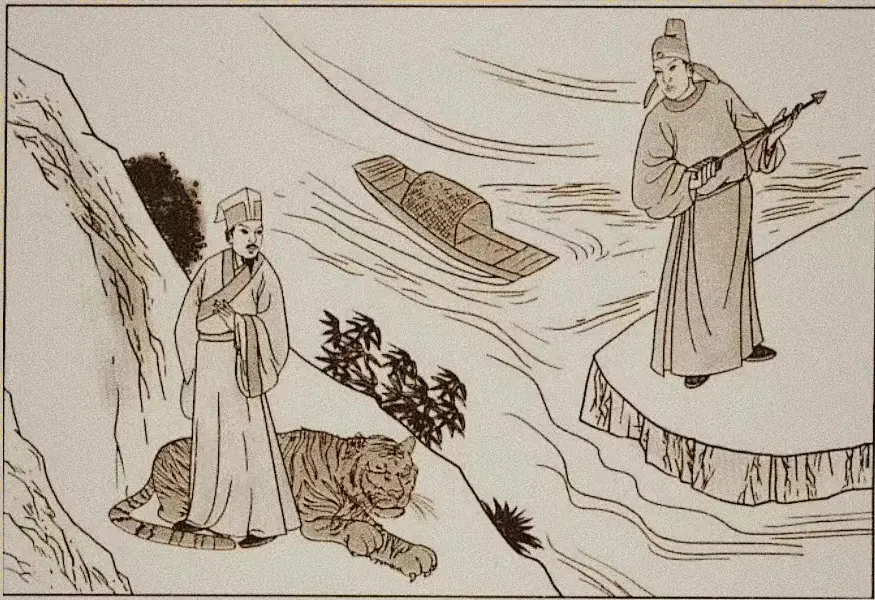
Scene Description
Image Symbolism
Reading the Picture
Li is brightness that needs something to cling to. The picture sets two figures on opposite banks, with an empty boat drifting between them.
Look first at the man on the left, standing calmly on a crouching tiger’s back. The Image Symbolism reads this as walking in danger without fear, and as a position hard to get down from: stepping off a tiger is the risky moment. That matches the first line’s confused footsteps, where respectful care keeps an energetic start from going wrong.
Across the water an official stands on a flat rock holding an arrow: someone in office, able to strike. Between them a covered boat sits midstream with nobody aboard. The symbolism reads it as quarrelling and indecision: there is a way across, but no one is steering. The lesson title mentions a bird in a net, which is not drawn.
Both trigrams are Fire ☲: a broken line held between two solid ones, bright outside and yielding within. The doubled fire shows in the two matching figures, each firm on his own ground. The fourth line, suddenly arriving and burning, warns what happens when that brightness turns aggressive, and the official’s arrow hints at it. The commentary’s answer is the yielding centre: brightness lasts when it rests on what is correct.
- Work
- If you hold a strong position, consider how you would step down safely, and who could carry on your work. Ask whether a rival across the water calls for an arrow or a boat.
- Relationships
- If two people have each taken their own bank, consider who could take up the empty boat. Brightness that clings to what is right, not to winning, warms instead of burning.
- Timing
- Fire flares and fades. If something started suddenly and fiercely, ask whether it can last; favour steady, respectful steps.
Line Statements
Listed from the bottom line to the top line.
- First nine: Confused footsteps. Respectful care brings no blame.
- Six in the second place: Yellow radiance. Great good fortune.
- Nine in the third place: Radiance of the declining sun. Without drumming on an earthen pot and singing, one laments great old age. Misfortune.
- Nine in the fourth place: Suddenly arriving; burning, dying, cast away.
- Six in the fifth place: Tears streaming, grieving and sighing. Good fortune.
- Top nine: The king goes out on campaign. There is praise for cutting off the leader and capturing those who are not his followers. No blame.
Meaning of the Hexagram
Translated from the Chinese 人间道 commentary with AI assistance; translator notes appear in brackets.
“Li: steadfastness is beneficial; success. Raising a cow brings good fortune.”
Of all things under heaven, none lacks something to cling to; its very form is that clinging. What a person clings to must be steadfast and correct; being correct, he can have success. A person who can cling to what is correct will surely be able to follow the right way, for to follow the good as water flows is human nature.
It is like the good fortune of the cow: the cow’s docility is formed through rearing, and so is a person’s compliant virtue. Having attached oneself to the right way, one should nurture oneself so as to complete one’s virtue.
“Li means clinging. The sun and moon cling to heaven; the hundred grains, grasses and trees cling to the earth.”
This is the state of clinging: just as sun and moon cling to heaven and the grains, grasses and trees cling to the soil, everything under heaven must have something it clings to; there is nothing that clings to nothing. A person must look at what he clings to, and only if it is correct can he have success.
“Doubled brightness clings to what is correct, and so transforms the world and brings it to completion. The yielding clings to the central and correct, hence success. That is why raising a cow brings good fortune.”
Above and below are both Li, hence “doubled brightness”: ruler and minister both have the capacity for clarity and handle affairs centrally and correctly, so they can teach and transform the world into a civilised way of life. And if people can also yield to the bright virtue of the central and correct, like the docile good fortune of the cow, they can make that bright virtue shine still more widely, setting off its beauty.
“Brightness doubled makes Li. The great person accordingly continues the brightness and illuminates the four quarters.”
If this hexagram were read merely as two Li, one would see only brightness and not know the virtue of continuing brightness. The noble person, observing the image of Li’s brightness following on from itself, knows that his own bright virtue can help the world. To let bright, central and correct virtue pass on to later generations, he needs the further capacity to continue the brightness: being clear about whom to choose to carry it on is the meaning of “continuing the brightness.”
Yao’s choice of Shun, and in the Han dynasty Cao Can following the rules laid down by Xiao He, are examples of continuing brightness in practice.
“Confused footsteps. Respectful care brings no blame.”
A yang line occupies the first place. This speaks of someone who, at the outset of advancing, has yang firm talent but advances restlessly. Because his movement is not fitting, he has already lost the role proper to a low position and incurs blame. But because he is a person of talent, he need only hold to what is right and be careful and cautious, and he will not come to blame.
“The respect shown in confused footsteps: by it one avoids blame.”
If one can recognise that restless advancing is a mistake and be respectful and cautious, then, since one is in a low position, it is enough simply to avoid such things, and there will be no harm. Those of us who have yang firm talent still need the capacity for clarity: one who is firm but not clear will bring disaster on himself through rash action.
“Yellow radiance. Great good fortune.”
Softness in the central place obtains the correct position. Yellow is the colour of the centre. If a person is refined and bright, central and correct, that is the height of beauty. Moreover there is the refined and bright ruler of the fifth six, who accords with this virtue. To be bright in this way is the good fortune of great goodness.
“Yellow radiance, great good fortune: it obtains the middle way.”
Refinement and brightness come from the empty clarity of the centre. So the cause of great good fortune is that it has obtained the way of the middle.
“Radiance of the declining sun. Without drumming on an earthen pot and singing, one laments great old age. Misfortune.”
The Changes has eight pure hexagrams, and of them only Li, as fire, sets out its meaning for human affairs in the finest detail. Here the third nine sits at the end of the lower trigram, meaning that the earlier brightness is about to end and the later brightness should carry on. Whatever has a beginning in human life must have its end; this is the constant way.
A person of wise and open understanding takes delight in following the order of things and holds to it constantly. One who cannot do so feels the sorrow of the approaching end and fears death day and night. So the noble person rejoices in heaven, while the petty person lives in fear all day long. Here the Changes discusses the way of life and death.
“The radiance of the declining sun: how can it last long?”
The sun has already tilted and cannot last long. A person of clarity can find others to carry on his work and knows to step back and cultivate himself; then he can endure.
“Suddenly arriving; burning, dying, cast away.”
The fourth position speaks of the beginning of continuing brightness, that is, of succession. But a yang line occupies it, firm and restless, though not losing the central and correct [sic; the sense requires ‘losing’]. This is not one who succeeds well. One who knows how to succeed well begins his succession with sincere modesty and knows to carry on the way of the worthy who came before.
Here he arrives suddenly and has already failed at good succession; moreover his firm power overrides his lord and his arrogance blazes high, hence “burning.” He will surely bring disaster and death on himself, hence “dying”; and since he is abandoned by all, the result is “cast away.”
“Suddenly arriving: there is no place that will receive him.”
Consider, all of you: a person who overrides his ruler and does not follow the worthy predecessor whom he succeeds will surely be abandoned by all; the world will not tolerate him.
“Tears streaming, grieving and sighing. Good fortune.”
Shedding tears, grieving and sighing all describe the deepest worry and fear. The ruler’s position is held by one with yin soft talent, pressed by yang firmness on either side. This is the clarity of one in the honoured position: he knows how to worry and to stand in awe, and so he can have good fortune. If instead he relied on his own insufficient talent and knew no fear at all, he could not obtain good fortune.
“The good fortune of the fifth six [the source writes 士 for 吉]: it clings to king and lords.”
The good fortune of occupying the high position lies in seeing clearly into the principles of affairs and holding to them with a heart of awe and concern; this can be good fortune.
“The king campaigns. There is commendation. He strikes off the chief, and those he takes are not the common followers. No blame.”
Yang firm talent at the end of Li has firmness and clarity at their height. This way is suited to a king going out on campaign: clarity is enough to perceive wrongdoing, and firmness can decide matters and carry out authority. In this way the wrongdoing of the world can be removed, and this has merit. When affairs in the world reach the point where punishment is not enough to stop them, they must be resolved by campaigns; this is such a time.
In removing the world’s wrongdoing, if clear judgment is pushed to its extreme, nothing will be pardoned. At such a time one must take only the chief, the one who started it all; to hunt everyone down and kill them all will surely bring regret for cruelty.
“The king campaigns: so as to set the state right.”
When a king uses this virtue he can govern his state; this is the supreme way of firmness and clarity.
Show the Chinese original (人间道)
离:利贞,亨,畜牝牛,吉。 天下万物莫不有所丽,其形即丽。人之所丽,必得贞正,得正可以亨通,人能附丽于正, 必能顺于正道,从善如流为人之性,如牝牛之吉,牛之顺道,由养而成,人之顺德亦同,既附 丽于正道,当有养以成其德也。
离,丽也。日月丽乎天,百谷草木丽乎土 。 附丽状,如日月丽于天,百谷草木丽于土 ,天下万物必有所丽,无丽之物,人必视何丽方 正,则能亨通也。 重明以丽乎正,乃化成天下。柔丽乎中正,故亨。是以畜牝牛吉也。 上下皆离故曰重明,乃意君臣皆有明之能,又处事中正,故可以教化天下成文明之俗也。
人又能柔顺于中正之明德如牝牛之顺吉,乃更能将明德发乎光大,衬托明德之丽。
明两作离,大人以继明照于四方。 此卦若云两离,则只见明,而不知继明之德。君子观离明相继之象,知本身之明德能济天 下,为使以明德中正永传后世,则须有进一步继明之能,能明于选择何人能承继,乃继明之义。 如尧之择舜,汉之萧规曹随等即是继明之用。
履错然,敬之,无咎。 初爻阳居之,乃言初进有阳刚之才而进又 躁动,却因动之非宜,已失居下位之分而得咎, 但因为人才,只须知守义而戒慎之,则不至于 有咎。
履错之敬,以辟咎也。 能知履动之躁进为错而敬慎之,因居下 位,但求避之可也,不致有灾。吾人有阳刚之 才,仍须有明之能,能刚不能明,则因妄动生 灾也。
黄离,元吉。 以柔居中乃得正位,黄为中色,人能文明 而中正,则美之至极也。又有六五文明之君以 顺其德,其能明如此,乃大善之吉也。
黄离元吉,得中道也。 能成文明乃由中之虚明,故元吉之因,是 由其得中之道也。
日昃之离,不鼓缶而歌,则 大耋之嗟,凶。 易有八纯卦,唯离为火于人事之义陈述最 细。今九三吾人居下卦之终乃意前明将尽,后 明当继之时,人之有始,必有其终,此常道也。 智虑通达之人,以顺理为乐且常持之,如不能 如此,则有将尽之悲,而日夜恐于死亡,故君 子乐天,小人终日恐惧,此处易论生死之道也。
日昃之离,何可久也。
日已倾,不可久也,能明之人,能求人以 继其事,知退而修其身,则可长久。
突如、其来如、焚如、死如、 弃如。 九四位,乃言继明之初,承继之意,但阳 爻居之,有刚躁但不失中正之意,此非善继者, 能知善继之人,始继必有谦让之诚,知顺承前 贤之道。今突如其来,已失善继,又刚势凌主, 气焰高张故焚如,必招祸害致死,故死如,以 众所弃之,故果为弃如。
突如其来如,无所容也。
诸君试想,人之凌其君,而不顺所承继之 前贤,必众弃,天下不容也。
出涕沱若,戚嗟若,吉。 出涕戚嗟,皆形容人忧惧至深。君位以阴 柔之才居之,又受于阳刚之在左右,此居尊位 之明,能知忧且畏,故能吉。今若自持己才之 不足,全然不知惧,必不能得其吉也。
六五之士,离王公也。 居上位之吉,乃在明察事理,且以畏惧忧 虑之心以持之,可以为吉也。
王用出征,有嘉。折首,获 匪其丑,无咎。 阳刚之才居离之终,有刚明至极之状。此 方式乃适用之于君王出征时,明则足以察邪 恶,刚则能断事,施以威行,如此则能去天下 之邪恶,此有功也。世上事至刑不足以阻时, 必用征伐方法解决,此之时也。去天下之邪恶, 如明断之极,则必无所宽宥,此时必取其魁首, 始作俑者方是,赶尽诛灭,必有暴残之后悔也。
王用出征,以正邦也。
君王用此德,则能治其邦国,此刚明至上 之道也。