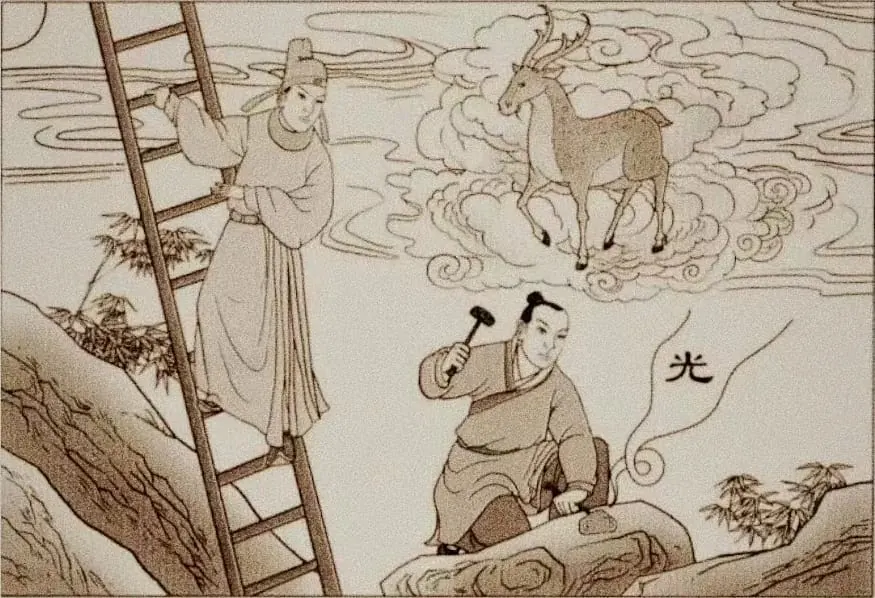
Scene Description
Image Symbolism
Reading the Picture
Qian shows strength on the rise: an official is climbing a ladder into the clouds, yet the picture keeps his ascent tied to the slow, careful work being done below.
Start with the official on the ladder. A ladder that reaches into the clouds is the scene’s image of swift advancement, The written description also places a moon overhead, a sign of a clear situation, although the artist did not draw it. Then look down at the stone, where the jade already gives off light while someone keeps working it. The Image Symbolism asks the climber to look back toward that worker: rising goes well when you remember the work that made it possible.
Both trigrams are Heaven, ☰ over ☰, six unbroken lines, and the scene repeats that doubled upward energy: clouds overhead, a figure climbing toward them, a deer among the clouds. The deer is a pun: 鹿 lù sounds like 禄 lù, reward or an official’s salary. It sits high in the clouds, out of reach: reward tends to arrive when you are not grasping for it.
The jade worker most clearly illustrates the third line: working diligently all day and staying watchful at night. The ladder points toward the fifth line’s flying dragon in heaven, and it also carries the top line’s warning: climb past what you can sustain and regret follows.
- Work
- If more responsibility is being offered, consider which skill still needs polishing before you take the next rung. Keep up the careful work that got you noticed.
- Relationships
- If you are the stronger or more visible partner, ask whether you still look back toward the other person and the everyday effort they put in.
- Timing
- The picture favours steady advancement with vigilance. If things are moving fast, ask where the top of your ladder is, and whether pushing further would turn strength into overreach.
Line Statements
Listed from the bottom line to the top line.
- First nine: Hidden dragon. Do not act.
- Nine in the second place: A dragon appears in the field. It is beneficial to see a great person.
- Nine in the third place: The noble person works diligently all day and remains watchful at night, as if in danger. No blame.
- Nine in the fourth place: Perhaps leaping in the depths. No blame.
- Nine in the fifth place: Flying dragon in heaven. It is beneficial to see a great person.
- Top nine: The overreaching dragon has regrets.
Meaning of the Hexagram
Translated from the Chinese 人间道 commentary with AI assistance; translator notes appear in brackets.
“Qian: origin, success, benefit, steadfastness.”
Origin is the first birth of all things; success is their growth; benefit is their fulfilment; steadfastness is their firmness of heart. This is the nature of Qian (The Creative), unchanged since antiquity. It shows that a person must have a firm and unwavering will; it is on this that every undertaking is accomplished.
“Hidden dragon. Do not act.”
The first line is a yang position, and a yang line occupies it. Because the principle of a line has no visible form, the sages borrowed the image of the dragon to show people the first image of Qian: like a sage when he first emerges, like the first beginnings of things, like a dragon lying hidden. Because it has only just come into being, this is not yet the time to be put to use. One should conceal one’s light and bide one’s time, waiting for the moment to arrive.
“A dragon appears in the field. It is beneficial to see a great person.”
For an individual, this time is like Shun when he farmed and fished: his virtue was already evident and his time had come, so it was beneficial for him to meet a ruler of great virtue in order to put his way into practice. For a ruler, this is likewise a time when it is beneficial to meet ministers of great virtue, so as to accomplish great work together. For the common people of the realm, it is beneficial to meet people of great virtue and talent, so as to receive their benefits.
“The noble person works diligently all day and remains watchful at night, as if in danger. No blame.”
The third line is at the very top of the lower trigram. Although it is a minister’s position, it has not yet left the lower ranks. At this time the noble person knows not to slacken from morning to night and stays alert at all times; even in a dangerous place, because of that vigilance no disaster comes.
Now consider a person in a low position whose virtue has become conspicuous, to whom the people’s hearts are turning, and toward whom the whole realm is about to turn: imagine how great his danger and apprehension must be. That is why the sages set a warning at this point. This is how the Changes discusses timing.
“Perhaps leaping in the depths. No blame.”
“Perhaps” marks a time between advancing and not advancing. The sages are warning about the timing of advance: if the timing is not right, one may also refrain from advancing. That is the meaning of “perhaps.” There is no disaster.
“Flying dragon in heaven. It is beneficial to see a great person.”
This is the time of advancing to the position of heaven, the ruler’s position. The realm benefits from meeting people of great virtue, who come to accomplish the great affairs of the world together. A sage who occupies this position knows that the time has come, and gathers people of great virtue from across the realm to accomplish it with him.
“The overreaching dragon has regrets.”
The top nine is the extreme point of the positions; to go beyond it is excess. The sage knows that this is the limit of the time, and so understands advance and retreat, survival and loss, and ends without fault; thus he does not come to regret.
“A flock of dragons appears without a leader. Good fortune.”
The way of “using nines” is the way of using pure yang firmness. Firmness must be balanced with yielding to reach the middle way. If one goes too far in firmness, to the point of putting extreme firmness first in the world, that is the way to misfortune.
“Great indeed is the originating power of Qian! All things owe their beginning to it, and so it governs heaven. Clouds move and rain falls, and every kind of thing flows into its form. Greatly illuminating end and beginning, the six positions are completed, each in its time; riding the six dragons in due season, it steers heaven. The way of Qian changes and transforms, so that each thing finds its true nature and destiny; preserving and uniting supreme harmony, it brings benefit and steadfastness. It rises first above the multitude of things, and all the states are at peace.”
The Tuan commentary gives the meaning of a whole hexagram; reading it helps us understand the hexagram. It begins by praising the vastness of the way of Qian, from which all things are born. Because the way of Qian governs heaven, it is the way of heaven itself. After things are born, clouds move and rain falls and every kind of thing flows into form: this is their growth. The positions of the six lines are each formed according to their time; this is the movement of heaven. Through the strong, unceasing working of the way of heaven, all things are produced, each with its own kind, its own nature and its own destiny. As we say, “What heaven bestows is destiny; what a thing receives is its nature.”
If one constantly holds to this way, then, because of the firm uprightness that the way of heaven produces, it is beneficial for us to be steadfast in heart toward the Way, and the result will surely be fortunate. The way of heaven goes first among all things and all of them prosper; the way of a ruler follows the way of heaven, so that all within the four seas submit willingly.
“Heaven moves with strength; the noble person accordingly strengthens himself without ceasing.”
The Image expresses the spirit of a hexagram. Every hexagram has an image and every line has an image; all the hexagrams take their image as their rule. As for the image of Qian, it is the same from beginning to end and never changes. If a person’s conduct can be like this, it is supremely strong, and in it one can see the way of heaven. Our unceasing self-strengthening is modelled on the law of heaven. This is the order of heaven.
“Hidden dragon, do not act: the yang is below.” Yang occupies the lowest position, where it is first born, like a plant growing in the soil that has not yet broken the surface, in the state of first sprouting. So a noble person in this time should advance in virtue and cultivate his work; it is not yet the time to be used.
“A dragon appears in the field: virtue spreads everywhere.” At this time the noble person’s virtue has already spread far and wide, and the people already feel the power of his teaching.
“Working diligently all day: going back and forth upon the Way.” At this time one is at the top of the lower trigram and wishes to move further forward, but has not yet shaken off one’s ties to the lower position. In advancing and retreating, moving and resting, one must follow the Way, and cultivate oneself and strengthen one’s virtue morning and night. This is the rule for this time.
“Perhaps leaping in the depths: advancing brings no blame.” “Perhaps” means advancing as far as is feasible and waiting for the right time; when the time comes, one moves, and in moving one must be clear-sighted. There is no disaster.
“Flying dragon in heaven: the great person rises to his work.” When the noble person can advance to the ruler’s position and practise the right way, the realm is well governed.
“The overreaching dragon has regrets: fullness cannot last.” What is full overflows; this is the way of heaven. So the Changes shows people that fullness cannot be held for long, and that excess is bound to produce regret.
“Using nines: heavenly virtue cannot take the lead.” “Using nines” means the way of using firmness. The way of heaven is yang and firm; to use firmness and also to put oneself first is excess.
The Commentary on the Words of the Text (Wenyan) says: “Origin is the chief of goodness; success is the gathering of excellence; benefit is the harmony of righteousness; steadfastness is the trunk of affairs.”
In the Changes only Qian and Kun have a Wenyan commentary; it reinforces the way of Qian and Kun, of heaven and earth. Origin: all things are good at their beginning; whatever heaven produces must have its use, and these are the traces of creation. Success is the excellence and beauty of their growth. Benefit: every action must accord with righteousness. Steadfastness: for all things to be put to use, they can only be accomplished with a firm and unwavering heart.
“The noble person embodies humaneness and so is fit to lead others.” Fair distribution is humaneness [the source wording here is terse and unclear]. This way of humaneness is great; the noble person embodies it and spreads his teaching through humaneness, and that is how he leads others.
“The gathering of excellence is enough to accord with ritual propriety.” What does not accord with principle is a breach of propriety; growth that accords with principle is the height of beauty and excellence. All things have their fixed laws; we must understand how principle orders things, so that our development accords with the natural way of heaven.
“Benefiting things is enough to accord with righteousness.” When one accords with righteousness, one can further the fulfilment of all things. “Coming after” is righteousness; being able to settle what comes after is righteousness [the meaning of these two sentences in the source is unclear]. Today the things that humans manufacture cannot be fully recycled, which throws the natural world out of balance. This does not accord with the way of righteousness, nor with the principle of benefiting things.
“Steadfast firmness is enough to carry out affairs.” With a firm and unwavering will, one is sure to accomplish things.
“The noble person practises these four virtues; therefore it is said: Qian — origin, success, benefit, steadfastness.” To be able to practise these four virtues is to accord with the way of Qian, of heaven.
“The first nine says, ‘Hidden dragon. Do not act.’ What does this mean? The Master said: It is one who has the virtue of a dragon but stays hidden. He does not change for the world and does not seek to make a name. He withdraws from the world without distress; he goes unacknowledged and feels no distress. What gladdens him he does; what troubles him he turns away from. Firm indeed, he cannot be uprooted: this is the hidden dragon.”
The use of Qian is the way of using nines. The first nine is the faint first appearance of yang firmness, like a dragon lying hidden. A sage living in a humble corner holds firmly to his way and does not change it because the world changes. When the time has not come, he conceals his conduct and does not seek to be known. He is self-assured and content; he moves when he sees that it is possible and avoids disaster when he recognises it, and his heart that keeps to the right way is firm and unwavering. This is the true hidden dragon.
“The second nine says, ‘A dragon appears in the field. It is beneficial to see a great person.’ What does this mean? The Master said: It is one with a dragon’s virtue who is correct and central. He is truthful even in ordinary words and careful even in ordinary deeds. He guards against what is false and preserves his sincerity. He improves his world but does not boast of it; his virtue is broad and transforms others. The Changes says, ‘A dragon appears in the field. It is beneficial to see a great person’: this is the virtue of a ruler.”
Though not in the ruler’s position, he has the virtue of centrality and correctness. He is careful in word and deed and seeks only to stand where there is no fault. When he meets crooked ways, he seeks only to preserve his sincerity. His virtue spreads widely, yet he does not boast of it. Pure and single in his sincerity, though he is not the ruler, he has a ruler’s virtue.
“The third nine says, ‘The noble person works diligently all day and remains watchful at night, as if in danger. No blame.’ What does this mean? The Master said: The noble person advances in virtue and cultivates his work. Loyalty and trustworthiness are how he advances in virtue; refining his words and establishing his sincerity are how he keeps to his work. Knowing where to arrive and arriving there, he can grasp the first signs of things; knowing where to end and ending there, he can preserve what is right. Therefore he is not arrogant in a high position and not anxious in a low one. So, diligent and watchful according to the time, though in danger he incurs no blame.”
One at the top of the lower trigram is already close to the ruler’s position, and because his ruler-like virtue is evident, he must avoid inviting misfortune. So a noble person at this time must seek to advance in virtue and cultivate his work, be careful in word and deed all day long, and know the turning points of advance and retreat; this is the way of righteousness. He is neither proud because he stands high nor anxious because he stands low, and gives no one cause to suspect him of ambition. So, though he is in a dangerous place, no disaster comes.
“The fourth nine says, ‘Perhaps leaping in the depths. No blame.’ What does this mean? The Master said: Rising and falling without fixed rule, but not for wrong ends; advancing and retreating without constancy, but not leaving his companions. The noble person advances in virtue and cultivates his work, wishing to do so in good time. Therefore there is no blame.”
“Perhaps” means that advancing and retreating must wait upon the time: sometimes going, sometimes stopping, never fixed for ever. The noble person moves in accord with the time as a shadow follows the body. He does not wish to be a crooked or petty person, nor does he wish to leave his own kind. This position belongs to someone close beside the ruler.
“The fifth nine says, ‘Flying dragon in heaven. It is beneficial to see a great person.’ What does this mean? The Master said: Things of the same note resonate with each other; things of the same vital energy seek each other. Water flows toward the wet; fire goes toward the dry. Clouds follow the dragon; wind follows the tiger. When the sage arises, all things look to him. What is rooted in heaven draws close to what is above; what is rooted in earth draws close to what is below. So each follows its own kind.”
A person of central and correct virtue occupies the ruler’s position, and everyone in the realm turns to him and looks up to his virtue. Those above respond to those below, and those below follow those above, so when the sage acts, all people understand. Because those of the same virtue are moved by one another, worthy people come forth, each according to their kind: those suited to high office draw close to the ruler, and worthy people of lower station stay near those in lower positions. This is the natural meaning of “water flows toward the wet, fire goes toward the dry, clouds follow the dragon, wind follows the tiger.” Therefore it is beneficial to see a great person.
“The top nine says, ‘The overreaching dragon has regrets.’ What does this mean? The Master said: Honoured but without a position, lofty but without people, with worthy people in lower positions but no one to assist him — so whatever he does brings regret.”
One who has the upright virtue of yang firmness but occupies an unsuitable position will surely regret any move he makes, because without people and without helpers it is hard to succeed by one’s own strength alone.
“Hidden dragon, do not act: he is below.” In a time of low position, even with central and correct virtue, one should stay hidden and not be put to use.
“A dragon appears in the field: the time lets him rest there.” He stops according to the time. This favours spreading his virtue widely within one area, but its range is limited.
“Working diligently all day: carrying out affairs.” This is the rule for how a noble person conducts affairs: when he is not in the ruler’s position, he stays watchful all day, advances in virtue and cultivates his work, and does not seek great achievements.
“Perhaps leaping in the depths: testing oneself.” Being at the ruler’s side, one can test what the timing is, moving or resting, advancing or stopping as conditions wax and wane. One must not advance rashly; that is the way to invite misfortune.
“Flying dragon in heaven: governing from above.” One who holds the ruler’s position and also has central and correct virtue is like a dragon in heaven: this is the highest form of government. That is the meaning here.
“The overreaching dragon has regrets: the disaster of reaching the end.” Because one is at the utmost extreme of exhaustion, one acts excessively; this is how disaster arrives.
“Qian’s origin, using nines: the realm is well governed.” Through the way of using nines, which heaven and the sage both know and both use, the realm is governed.
“Hidden dragon, do not act: the yang energy is hidden away.” This is the time when yang is weak and lies hidden; the noble person follows its example, also staying in obscurity, and is not to be used.
“A dragon appears in the field: the realm becomes bright and cultured.” When the dragon’s yang, firm virtue appears on the ground, the realm sees its culture and brightness.
“Working diligently all day: moving together with the time.” Wait for the time to act, and do not slacken for even a moment.
“Perhaps leaping in the depths: the way of Qian is about to change.” Because he knows what is fitting in advancing and retreating, he can leave the lower trigram and leap into the upper position; hence the text speaks of a change between upper and lower.
“Flying dragon in heaven: he takes his place in heavenly virtue.” Rightly placed in the ruler’s position, heavenly virtue becomes manifest, like a dragon rising to heaven.
“The overreaching dragon has regrets: reaching the extreme together with the time.” The time has passed; to remain in this time is for both the person and the time to go too far.
“Qian’s origin, using nines: the law of heaven is revealed.” Using nines is the law of heaven, and the law of heaven is the way of heaven. The sage acts in accordance with the Way, so gain and loss, fortune and misfortune are known at the very start of affairs. This is the law of heaven.
“Qian’s origin is what begins and brings success.” Using the yang, firm law of heaven, there is success from the very start.
“Benefit and steadfastness are its nature and disposition.” Once the yang, firm nature has achieved success, it must remain the same from beginning to end; then it can bring forth life without ceasing.
“Qian’s beginning can benefit the world with beauty and benefit, yet it does not speak of what it benefits. How great!” The way of Qian’s beginning lets the whole world feel its beauty and benefit from it, yet it does not sing its own praises or claim the credit; this is truly great.
“Great indeed is Qian! Strong and firm, central and correct, pure, unmixed and refined. The six lines unfold it, reaching into every circumstance. Riding the six dragons in due season, it steers heaven. Clouds move and rain falls, and the world is at peace.”
This speaks of the greatness of the way of Qian. Because it is purely strong, firm, central and correct, and proceeds step by step, in accord with the time and the position, it can govern the world; yin and yang are in harmony, and the world enters the way of peace.
“The noble person takes accomplished virtue as his conduct, conduct that can be seen every day. ‘Hidden’ means concealed and not yet seen, acting but not yet accomplished; so the noble person does not act.” The noble person shows his virtue to others through conduct that can be seen at any time. At first, because he is still hidden and not yet put to use, the noble person does not act.
“The noble person learns in order to gather knowledge, asks questions in order to discern, is generous in how he dwells, and acts with humaneness. The Changes says, ‘A dragon appears in the field. It is beneficial to see a great person’: this is the virtue of a ruler.”
When a sage is in a low position, with his virtue already evident but not yet given a position, he must seek to advance in virtue and cultivate himself. He does not blame the times for not favouring him, but seeks only to put it into practice in his own person. Though he is not the ruler, this is the virtue and ability of a ruler.
“Doubly firm but not central; above, not in heaven; below, not in the field. Therefore, diligent and watchful according to the time, though in danger he incurs no blame.”
Because the third nine is past the centre and sits at the top of the lower trigram, it is the position of a chief minister. Above, it has not yet reached the ruler’s position, and its nature is yang and firm, so it is a place of danger and apprehension. The sage knows to take warning, and is careful and vigilant to guard against danger; so, even in this time, there is no blame.
“Doubly firm but not central; above, not in heaven; below, not in the field; in the middle, not among people. Therefore it says ‘perhaps.’ ‘Perhaps’ expresses doubt. Therefore there is no blame.”
The fourth nine is close to the ruler’s position and is also a place of danger. Whether advancing or retreating, one seeks only to be safe, and so there can be no blame. The noble person can bend and can stretch.
“The great person is one whose virtue accords with heaven and earth, whose brightness accords with the sun and moon, whose order accords with the four seasons, and whose fortune and misfortune accord with the ghosts and spirits. When he acts ahead of heaven, heaven does not oppose him; when he acts after heaven, he follows heaven’s timing. If even heaven does not oppose him, how much less will people? How much less the ghosts and spirits?”
The sage knows ahead of heaven, so heaven is at one with him; coming after heaven, he follows heaven. This accords with the way of heaven, so neither people nor ghosts and spirits can go against him. Heaven is supremely great; what exists between heaven and earth is the Way. Ghosts and spirits are the traces of creation and transformation.
“‘Overreaching’ means knowing how to advance but not how to retreat, knowing how to survive but not how to perish, knowing how to gain but not how to lose. Is it only the sage? One who knows advance and retreat, survival and loss, without losing what is right — is it only the sage?”
The meaning of “overreaching” is not knowing the turning points of advance and retreat, survival and loss. The sage knows what overreaching is and, placed in this situation, does not depart from the right way in anything, so he does not overreach. Only a sage can do this.
Show the Chinese original (人间道)
干:元、亨、利、贞。 元为万物之始生,亨为万物之成长,利为万物之遂成,贞为万物之坚心,此为干之性,恒 古不变,示人须有坚定不移之心志,万事乃成于此。
潜龙勿用。 初爻为阳位,且阳居此,因爻理本无形, 圣人假借龙之物象来示人干之初象如圣人始 萌,如物之始端,若龙之潜隐,由于始生,未 为可用之时机,当韬光养晦,以俟时之至。
见龙在田,利见大人。 以个人而言,此时如舜之田渔,其德已着, 乃时之至,故利见大德之君,以行其道。以君 王言,此时亦利见大德之人臣,以共成其功。 以天下百姓言,亦利见大德之人才,以受其恩 泽。
君子终日干干,夕惕若厉,无咎。 三爻位是在下卦之最上,虽为臣位,但未离下位,此时君子知朝夕不懈,随时警惕,即处 危地,但因戒惕而无灾至。时今在下位之人,因德已显彰,民心将至,天下将归于他,试想其 危惧之程度,故圣人设戒于此时,此易之论时也。
或跃在渊,无咎。 或乃进与不进之时,圣人示戒进之时机,如时机不对,亦可不进,或之意也,无灾。
飞龙在天,利见大人。 此乃进乎天位君位之时,天下利见有大德 之人,来共成天下之大事,圣人居此位,乃知 时之至矣。广纳天下大德之人共成之。
亢龙有悔。 上九为位之极点,过此时太过也。圣人知 此为时之极限,乃知进退存亡而终至无过,就 不至于后悔也。
见群龙无首,吉。 用九之道,即用鲍阳刚之道,须刚柔相济方为中道,如过乎刚,以至刚为天下之优先,此 凶之道也。
大哉干元!万物资始,乃统天。云行雨施,品物流形。大明终始。 六位时成,时乘六龙以御天。干道变化,各正性命,保合大和, 乃利贞。首出庶务,万国咸宁。 彖为一卦之义,吾人观读彖,有助于对卦之了解。开始即讃干道之浩大,万物由此而生, 干道因统天,故即为天道,万物生后,云行雨施,品物流形,此物之长也。
六爻之卦位,各因 时而成,此为天之运行,因天道之刚健而自强不息的运作,生育出万物,且各有分类,各有所 性,各有所命。吾人言『天所赋为命,物所受为性。』自此常存此道,因天道生成之 刚正,利于吾人坚心向道,果必吉。天之道首出万物而皆亨吉,人君之道遵循天道,以致 四海顺从。
天行健,君子以自彊不息。 象为解一卦之神,每卦皆有象,每爻皆有象,所有的卦皆以象为法则。此干之卦象言,始 终如一,永恒不变,人之行为能如此则至健,可以见天道也。吾人之自强不息,乃法天之则也。 此为天纪。 潜龙勿用,阳在下也。 阳居最下始生之位,犹植物之生于土中, 未出头,始萌之状。
故君子如处此时,乃应进 德修业,未为可用之时机也。 见龙在田,德施普也。 此时君子之德已普及各地,人民已感受其 教化之力量也。 终日干干,反复道也。 此时居下卦之最上,要再进前,但又未脱 下位之关系,进退动静,必依有道,且旦夕进 修励德,此时之法则也。 或跃在渊,进无咎也。
或乃量可而进,待之以时,时至而动,动 必以明,无灾。 飞龙在天,大人造也。 君子能进君位,而行其正道,天下大治矣。 亢龙有悔,盈不可久也。 满则溢,此天之道也,故易示人满必不可 持久,太过必生悔矣。 用九,天德不可爲首也。 用九,意为用刚之道也,天道阳刚,又用 刚而为先,此之过矣。
文言曰:元者,善之长也;亨者,嘉之会也;利者,义之和也;贞者, 事之干也。 易中唯乾坤二卦有文言,此乃补强乾坤天地之道。元,万物之始皆为善,天之生必有其用, 此为造化之迹也。亨者,乃其成长之嘉且美也。利者,任何行为必合于义也。贞者,万物之用, 必以坚心不移方可成矣。
君子体仁,足以长人。 分均,仁也,此仁之道大矣,君子体之,以仁普及教化,以所以长人也。 嘉会,足以合礼。 不合理则为非礼,合于理之生长,为美之至嘉也。故万般事物皆有一定之法则,吾人须体 理之治,则发展合于天道自然。 利物,足以合义。 合于义,则能利于万物之遂行。
后出,义也。能断后,则为义也。而今人类制造之物,无 法完全回收,造成自然界之失衡,此不合于义之道也,不合于利物之理。 贞固,足以干事。 因坚定不移之意志,则定以成事。 君子行此四德者,故曰:干,元,亨,利,贞。 能行此四德,则合乎干天之道。 初九曰:潜龙勿用,何谓也?
子曰: 龙德而隐者也,不易乎世,不成乎 名,遁世无闷,不见是而无闷,乐 则行之,忧则违之,确乎其不可拔, 潜龙也。 干卦之用,即用九之道。初九为阳刚之微 现,如龙之潜隐,圣人居之陋侧,坚守其道不 因世之变而改变,时不至,隐其行,不求为人 知也,自信自乐,见可而动,知灾而避,守正 道之心坚而不移,此真潜龙也。
九二曰:见龙在田,利见大人,何 谓也?子曰:龙德而正中者也。庸 言之信,庸行之谨,闲邪存其诚, 善世而不伐,德博而化。易曰:见 龙在田,利见大人,君德也。 因非为君位,但有中正之德,谨言慎行, 但求处于无过之地,遇邪道,但求存诚,德施 普及,但不伐其恶,以诚纯一,虽不为君,但 为君之德也。
九三曰:君子终日干干,夕惕若厉, 无咎,何谓也?子曰:君子进德脩 业,忠信所以尽德也;脩辞立其诚, 所以居业也。知至至之,可与几也; 知终终之,可与存义也。是故居上 位而不骄,在下位而不忧,故干干 因其时而惕,虽危无咎矣。 位居下卦之上者,已近君位,又因有君之 德显,为免招凶,故君子居此时,必求进德修 业,终日谨慎言行,知进退之机,此义之道。
不以居上位或处下位而骄傲或忧虑,不予人有 野心之戒,故虽处危地但无灾至也。 九四曰:或跃在渊,无咎,何谓也? 子曰:上下无常,非爲邪也;进退 无恒,非离群也;君子进德脩业。 欲及时也,故无咎。 或即进退须待时之意,时行时止,不可恒 久不变。君子之顺时而动,犹影之随形,并非 欲为邪吝之人,亦非欲离同类也。
此位乃近君 恻之人也。 九五曰:飞龙在天,利见大人,何谓也?子曰:同声相应,同气相求, 水流湿,火就燥,云从龙,风从虎,圣人作而万物睹。本乎天者亲上, 本乎地者亲下,则各从其类也。 此有中正之德的人,居于君王之位,天下人皆归仰其德,上应于下,下从于上,故圣人做 而万人皆明,因同德相感,故贤人出,各有其类,本为君位之人则亲和于君王,本为位低之贤, 则近于下位之人,此乃自然之水流湿,火就燥,云从龙,风从虎之义。
故利见大人。上九曰:亢龙有悔,何谓也?子曰:贵而无位,高而无民,贤人在下位 而无辅,是以动而有悔也。 有阳刚之正德而居不适位,则动而必悔,因无民无辅,独力难成也。 潜龙勿用,下也。 居下位之时,即有中正之德,亦宜潜隐, 不可就用也。 见龙在田,时舍也。 因时而止,此利普施其德于一地,范围有 限。
终日干干,行事也。 君子行事之法则,不居君位,则终日警惕, 进德修业,不求有大功。 或跃在渊,自试也。 处君侧,可自试时机为何,动静随消息而 进或止,不可躁进,求凶之道。 飞龙在天,上治也。 有君王之位人,又有中正之德者,如龙在 天,乃上上之治,其意如此。 亢龙有悔,穷之灾也。
因穷困之极,乃有太过之举动,此灾之至 也。 干元用九,天下治也。 用九之道,因天与圣人同知且同用,天下 因治。 潜龙勿用,阳气潜藏。 方阳衰而潜藏之时,君子效此,亦晦隐, 不可用也。 见龙在田,天下文明。 龙之阳刚德性,见于地上,如此天下则见 其文明也。 终日干干,与时偕行。
待时而动,不可分秒懈怠。 或跃在渊,干道乃革。 因知进退之得宜,故能离下卦,而跃居上 位,故曰上下之革。 飞龙在天,乃位乎天德。 正于君位,天德乃现,如龙升天。 亢龙有悔,与时偕极。 时之过,再居此时,则人与时皆过也。 干元用九,乃见天则。 用九,乃天之则也,天之法则即为天道, 圣人禀道而行,得失吉凶立知于事之初,此为 天则。
干元者,始而亨者也。 用阳刚之天则,初始即可亨通也。 利贞者,性情也。 阳刚之性既亨通,须始终如一,则能生生 不息。 干始能以美利利天下,不言所利,大矣哉。 干始之道,能使天下皆感其美,而天下因之而利,又不歌功颂德,将功归己,此则大矣。 大哉干乎!刚健中正,纯粹精也;
六爻发挥,旁通情也;时乘六龙, 以御天也;云行雨施,天下平也。 此言干道之伟大,因纯之刚健中正,按步就班,顺时顺位而行之,则可以统御天下,阴阳 和畅,天下则进入和平之道也。 君子以成德爲行,日可见之行也。潜之爲言也,隐而未见,行而未 成,是以君子弗用也。 君子以行为而示人其德性,随时可见。
初因方潜未为见用,故君子弗用也。 君子学以聚之,问以辩之,宽以居之,仁以行之,易曰:见龙在田, 利见大人,君德也。 圣人居下位,德已显,却未得位时,必求进德修身,不怪时之不与,但求身体 力行此虽不为君,却是为君之德才。
重刚而不中,上不在天,下 不在田,故干干因其时而惕,虽危 无咎矣。 因九三位为过中而又居下卦之上,属相 位,上又未至君位,又为阳刚之性,故属危惧 之地,圣人知戒,竞竞惕惕以防危,故虽处此 时而无咎也。
重刚而不中,上不在天,下 不在田,中不在人,故或之;或之 者,疑之也,故无咎。 九四为近君位,亦属危地,或进或退,但 求平安耳,故可无咎。君子能曲能伸。
夫大人者,与天地合其德,与日月合其明,与四时合其序,与鬼神 合其吉凶,先天而天弗爲,后天而奉天时,天且弗违,而况于人乎?况 于鬼神乎? 圣人先知于天故天与其同,后于天又顺于天,此合乎天道,故人与鬼神皆不能违,天为至 大,存天地之间,道也。鬼神,造化之迹也。 亢之爲言也,知进而不知退,知存而不知亡,知得而不知丧,其唯 圣人乎!
知进退存亡,而不失其正者,其唯圣人乎! 亢之义乃不知进退存亡之机也,圣人知亢而处此,凡事皆不失正道,故不为亢,唯圣人可 为也。